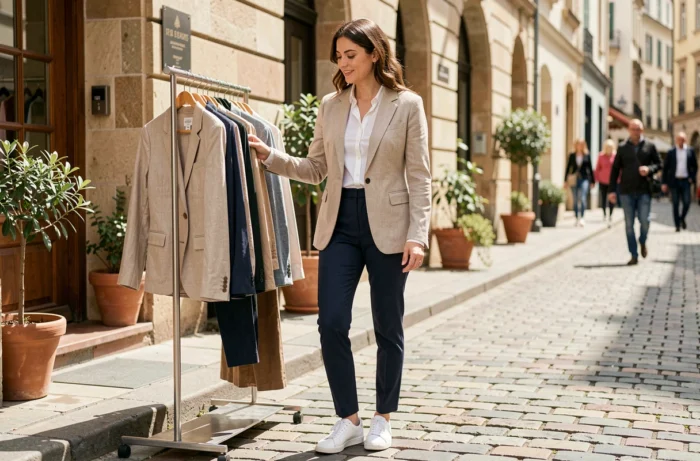
Expressing your personal style every day doesn’t mean systematically buying new, certified pieces. Most French people cite extending the life of clothing as the most important way to reduce the environmental impact of textiles. Building a cohesive wardrobe comes down to three practical steps: making the most of what you already own, repairing clothes, and sourcing missing pieces second-hand.
Clothing repairs and second-hand shopping: two underrated ways to express your style
Second-hand shopping can attract between ten and thirty percent of new customers for brands and retailers that develop a circular offering. This figure points to a shift: the resale market is no longer just a way to clear excess stock; it’s a customer acquisition channel in its own right.
In practice, a vintage or second-hand piece often brings more individuality than something from the current collection. A high-waisted pair of 1990s trousers or a structured blazer found in a thrift shop has no equivalent on today’s rails. A piece’s uniqueness defines your style, not its original price.
When it comes to repairs, a little technical know-how can extend a garment’s life and change its silhouette. Shortening trousers, adjusting a coat’s shoulders, or replacing a jacket’s buttons can turn a tired piece into a wardrobe staple. Detailed content on these approaches is regularly published in Perceptis’s fashion section, with a focus on building a sustainable wardrobe.
We find that people still confuse “responsible fashion” with “buying new, responsibly made clothes.” Extending the life of a garment you already own remains the most effective step—far more so than replacing it with an equivalent made from organic cotton.

French regulations: what’s changing for fashion trends
Ultra-fast fashion is facing direct regulatory changes in France. The adopted law aims to penalize accelerated production models through environmental surcharges and advertising restrictions. For consumers, the message is clear: fast-turnover items will become more expensive and less visible.
Environmental labeling, introduced as voluntary in October 2025, is beginning to change how people make purchasing decisions. A score displayed on a label or product page can steer shoppers toward better-rated materials and supply chains, without requiring them to choose a particular brand.
The digital product passport for clothing is not yet mandatory. According to an analysis published by Projet Celsius on November 12, 2026, the specific European legislation for textiles is still pending, and its timeline may change. There’s therefore no immediate benefit to factoring this measure into your wardrobe planning, but it will eventually change how second-hand items are traced.
Practical implications for choosing clothes
- Items from ultra-fast-fashion supply chains will become less attractive on price as upcoming surcharges take effect, making second-hand clothing even more competitive in terms of value for money.
- Voluntary environmental labeling makes it possible to compare two similar items using an objective criterion, beyond price or brand alone.
- Repairs are not subject to any tax and do not receive a negative environmental score, making them the most regulation-neutral option.
Build everyday outfits from the clothes you already own
Before adding anything, take stock of what already works. Three categories form the basis of a functional wardrobe: neutral basics (straight-leg trousers, a plain T-shirt, a shift dress), statement pieces (a pattern, an unusual cut, a bold color), and finishing accessories (a belt, scarf, or versatile pair of shoes).
A convincing everyday outfit combines a basic with a statement piece: dark trousers with a patterned top, or a plain dress with a structured jacket. The rule can be summed up in one sentence: one visual focal point per outfit is enough to express your style.
Seasonal fashion without overconsumption
Seasonal trends—such as a dominant color, shorts length, or collar shape—don’t require a complete wardrobe refresh. An accessory or alteration is often enough to capture the look of the moment. Wearing a scarf in the season’s color with a coat you already own has the same effect as an entirely new outfit.
Pink, sky blue, and other shades highlighted on the runways are easy to find in thrift shops and consignment stores, often for a fraction of their original price. Looking for trends second-hand calls for more careful selection, which paradoxically sharpens your eye and makes your style more cohesive.
Trend-led pieces to prioritize: trousers, dresses, and accessories
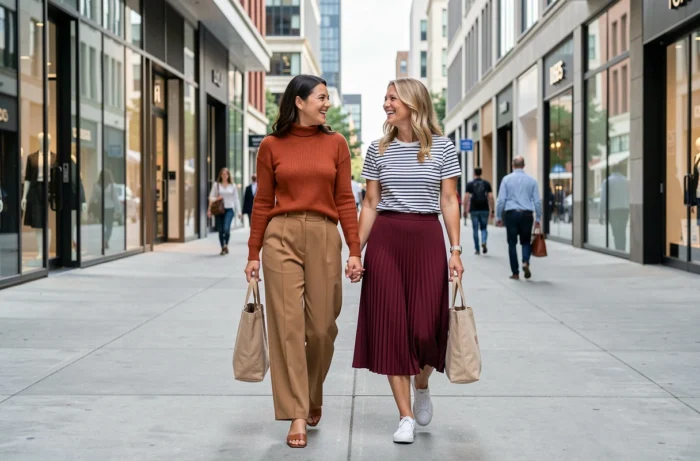
If you still want to add something new, it’s worth choosing versatile pieces. A well-cut pair of trousers can work across several seasons without losing its style appeal. Wide-leg trousers, a fixture on recent runways, look just as good with sneakers as with ankle boots.
The midi dress remains a long-lasting wardrobe staple. It works in spring and fall with a simple change of layer—a cardigan, denim jacket, or trench coat. As for accessories, a striking pair of earrings or a structured bag can elevate any basic outfit without adding bulk to your wardrobe.
- Wide-leg trousers in heavyweight fabric: rolled up in spring and worn with knee-high socks in fall. One piece for two seasons.
- Plain shirt dress: worn on its own in summer and layered over a turtleneck in winter. The ultimate four-season piece.
- Well-made leather belt: often available second-hand for just a few euros, it adds shape to an overly loose outfit.
Style isn’t measured by how many pieces you buy each season. A smaller wardrobe that’s well cared for and thoughtfully supplemented creates a sharper look than a closet packed with micro-trends. Your next addition may already be in your closet, waiting for an alteration or a pairing you haven’t tried yet.