
A wall that seems too narrow, a living room where the light stops halfway, a bedroom that lacks character: we often start with a specific annoyance before thinking about decoration. Transforming your home doesn’t necessarily require major renovations or a significant budget. A few targeted interventions on the coverings, lighting, or furniture arrangement are enough to radically change the atmosphere of a room.
Lead diagnosis before decoration: an expanded obligation since 2026
Before touching a wall in an old home, we tend to rush in with a pot of paint. Since the decree of August 3, 2026, amending the decree of August 19, 2011, the lead diagnosis now covers all coverings, not just paints. Plasters, certain exterior coverings: the scope of the lead exposure risk assessment (CREP) has been broadened.
Specifically, if you plan to sand, scrape, or strip old layers, the ARS Auvergne-Rhône-Alpes strongly advises against dry sanding and using an electric sander on these surfaces. The recommendation is to favor covering (wallpaper, fiberglass, tiles) rather than stripping. You can find ideas and practical feedback on the site www.lesconseilsdemelanie.fr maison to adapt your decor projects to this type of constraint.
This regulation changes the game for anyone looking to refresh an interior built before the 1950s. Covering rather than stripping protects health and simplifies the project.
Natural colors and materials: composing a coherent palette room by room
Everywhere you read that you should “dare to use color.” The problem is that you often end up with a terracotta wall in the living room, sage green in the bedroom, and duck blue in the entrance, with no connection between the rooms. Coherence comes from a guiding thread: choose two to three base shades and vary their intensity according to the spaces.
Start from the floor and work your way up
The color of the floor dictates everything else. A light wood floor calls for soft tones (linen, off-white, pearl gray) and tolerates a more intense accent wall. Conversely, dark tiles in a kitchen or bathroom require light walls to avoid overwhelming the space.
Natural materials (raw wood, rattan, linen, stone) act as living neutrals. They add texture without visually saturating the space. A wicker basket, a crumpled linen throw, or a solid wood shelf are enough to warm up a white wall.
- Always test a paint sample directly on the wall in question, as the natural light in the room radically changes the perception of the shade.
- Limit accent walls to one per room to avoid visual overload, especially in spaces smaller than fifteen square meters.
- Pair a matte material (plaster, velvet paint) with a shiny material (mirror, glass, brass) to create relief without adding extra color.
Rearranging your furniture before buying new ones
We underestimate how much moving a sofa or rotating a table changes the flow and perception of a living room. Before any spending, testing two or three different configurations with existing furniture allows you to identify what is really blocking: an oversized piece, a too-narrow passage, an unused dead angle.
Clear the pathways
In a living room, the path between the door and the sofa should remain clear at least 70 centimeters wide. If you have to go around a coffee table to sit down, it’s often the table that is poorly placed, not the sofa. Clearing the passages transforms the feeling of space more effectively than a new piece of furniture.
In a bedroom, moving the bed away from the side wall to create a passage on both sides makes daily life easier and gives an impression of volume. Feedback varies on this point when the room is very small, but in most cases, even twenty centimeters on each side makes a difference.
Decorative lighting: multiply sources rather than relying solely on the ceiling light
A central ceiling light illuminates but flattens. To give depth to a room, we work with layers of light: a high source (suspension or dimmed ceiling light), an intermediate source (wall lamp, floor lamp), and a low source (table lamp, garland placed on a shelf).
Adjust the color temperature for each room
A warm light in the living room and bedroom, a neutral light in the kitchen and office. This simple distribution avoids cold atmospheres where comfort is sought and drowsiness where concentration is needed.
- Replace a single ceiling light with two or three fixtures distributed throughout the room to eliminate shadowy areas.
- Install dimmers on the lamps in the living room and bedroom: the same space can shift from work ambiance to relaxation ambiance in seconds.
- Use tall plants or open shelves near windows to filter natural light without blocking it, reducing the need for artificial lighting during the day.
Textiles and accessories: the cheapest levers to decorate a room
Changing curtains, adding cushions in a new palette, or placing a structured rug under the coffee table are quick gestures with a strong visual impact. Textiles modify acoustics as much as aesthetics: a tiled living room with a large wool rug absorbs sound and gains comfort.
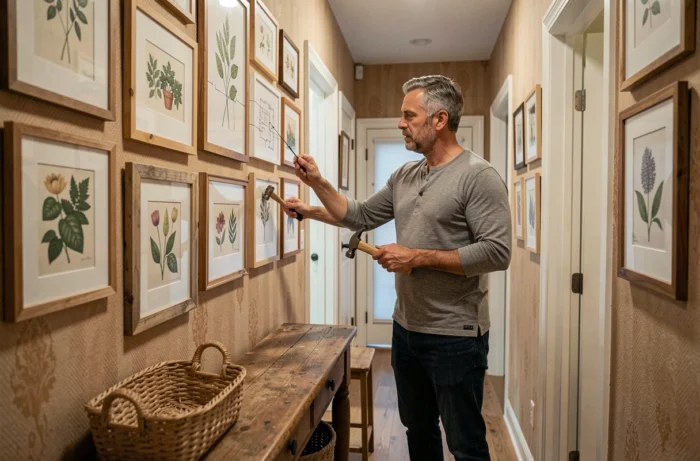
On the walls, a well-chosen frame or poster is better than an accumulation. It’s beneficial to group frames into a single composition (aligned on a horizontal axis or in an asymmetrical arrangement) rather than scattering them across four different walls. The eye needs a focal point, not a dozen distractions.
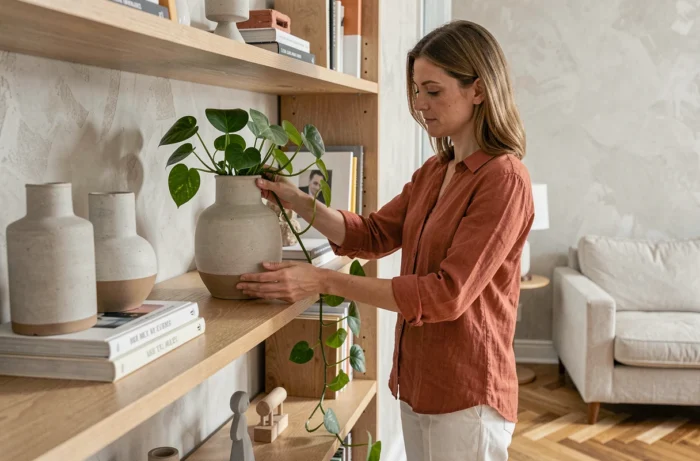
Plants remain a classic that works. A ficus or monstera in an empty corner fills the space, adds color, and filters light. For less bright rooms, pothos or sansevieria tolerate shade very well.
Transforming your home rarely involves a major project. Checking regulatory constraints on coverings, building a coherent palette, rethinking the layout before buying, working with layered lighting, and focusing on textiles: these five levers, combined, profoundly change the atmosphere of an interior without requiring an extravagant budget.