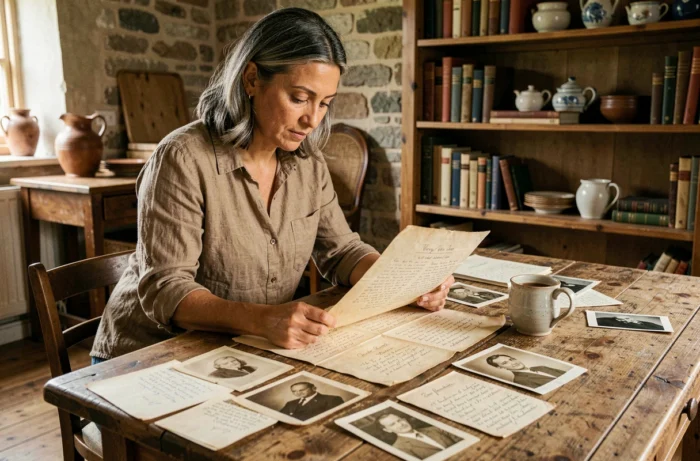
When you come across a baptism certificate written in Latin with half-faded ink, or you stumble upon a Parisian ancestor whose records were burned in 1871, genealogy stops being a quiet hobby. Research into our family roots has been moving quickly in recent months, with accelerated digitization of departmental archives, new military collections available online, and legal debates surrounding genetics applied to investigations. The landscape has changed, and so have the tools.
Online matriculation registers up to 1925: what it concretely unlocks
Until recently, tracing the military service of a great-grandfather mobilized in 1914 often required a physical trip to the departmental archives. The FranceArchives portal has expanded its collections of online matriculation registers up to 1925, pushing the research boundary for millions of military records.
In practice, we can now access the records of soldiers demobilized after the Great War, including those who continued service in the 1920s. Before this expansion, researchers had to deal with the fragmentation of departmental sites, each having its own online publication schedule.
To keep up with the news on Cultivons nos Racines, it allows you to quickly spot which collections have just been published, without having to sift through each departmental portal one by one.
This advancement does not solve everything. Feedback varies on the quality of indexing depending on the departments: some offer name searches, while others provide access only by registration number and recruitment class. Before searching, you need to know the recruitment office of the ancestor, information typically found in population censuses or civil status records.
Departmental archives: accelerated digitization and virtual reading room
French departmental archives are no longer content with maintaining their existing collections. There is an acceleration in local digitizations covering various sources:
- Notarial registers, which complement civil status when records are missing (marriage contracts, inventories after death, wills)
- Population censuses, useful for locating a family at a specific date and identifying neighbors, often witnesses in the records
- Municipal deliberations and old photographs, which add historical context to a lineage
A recent notable development concerns Val-d’Oise, which has opened a virtual reading room to consult documents that cannot be accessed in person. For distant genealogists or those working on restricted access collections, this is a concrete change in usage. There is no longer a need to take a day off to consult a specific register.
How to leverage these new online resources
The reflex to adopt: systematically cross-reference notarial acts with civil status. A marriage certificate provides a name and a date. The marriage contract drawn up before a notary reveals assets, witnesses, sometimes the exact profession and the parents’ place of residence. It is often in these documents that you unlock a branch that has been stagnant for months.
Municipal deliberations, long neglected, also deserve a look. They mention names of residents in specific contexts: requests for assistance, appointments of rural guards, land disputes. You can find traces of ancestors that do not appear anywhere else.
Genetic genealogy and criminal investigations: the censorship of the Constitutional Council
The use of genetic genealogy in criminal investigations has experienced a sudden turnaround in France. A bill had been debated in committee to allow the use of genealogical DNA databases in unsolved cases. The Constitutional Council censored this provision, putting a halt to this practice already common in other countries.
This decision has direct repercussions on the world of amateur genealogy. The issue of DNA testing remains a sensitive topic in France, where its use for personal purposes is still prohibited on the territory, even though many French people resort to it through foreign platforms.
What it changes for personal research
From a strictly genealogical standpoint, the censorship does not alter existing rules. DNA tests ordered from abroad remain in a legal gray area. However, the signal sent by the Constitutional Council distances the prospect of a legal framework in France for genetic genealogy, whether for judicial or personal purposes.
For researchers already using DNA matches via international platforms, the results remain usable as clues, never as proof. One always cross-references with paper archives before validating a lineage.
Digital tools for genealogy: beyond online trees
The digital ecosystem surrounding genealogy is expanding beyond major collaborative tree portals. A concrete example: the Firefox extension Pont Généalogie, referenced by the National Agency for Territorial Cohesion, facilitates navigation between different databases without multiplying tabs.
Artificial intelligence is also beginning to make its way into paleographic reading. Deciphering a 17th-century document written in old cursive remains one of the major obstacles for amateurs. Several projects are testing handwriting recognition models adapted to French archival documents.
- The Pont Généalogie extension simplifies the transition between departmental archive portals and national databases
- AI tools applied to paleography are starting to assist in the transcription of old documents
- The Central Notarial Archives of Paris has seen over a million images transmitted to collaborative platforms, expanding access to Parisian notarial acts
These advancements do not replace the method. An automatic transcription tool may offer an incorrect reading of a surname, and an error in a name propagated in an online tree becomes very difficult to correct. Manual verification remains the last reliable filter.
The landscape of genealogical research in France is transforming in small ways, but each counts. Between military records now accessible online, virtual reading rooms, and debates surrounding DNA, we have more raw material than ever to reconstruct a family’s history. The real challenge is no longer access to documents, but their methodical cross-referencing.