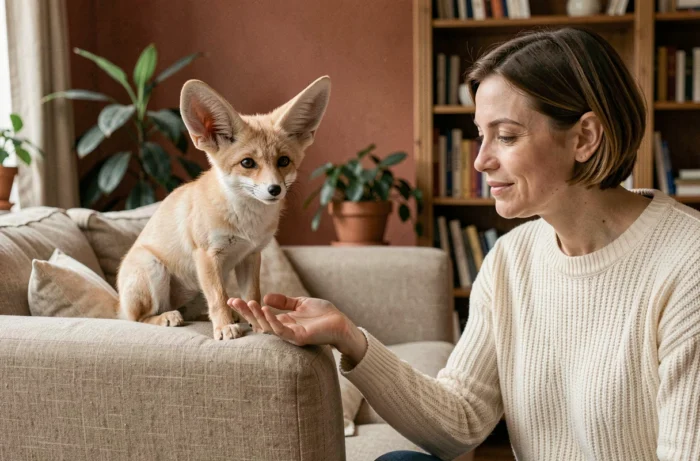
The fennec (Vulpes zerda) is a wild canid native to the Sahara, classified in France as non-domestic NAC. Its ownership by an individual falls under the Environmental Code and requires specific administrative authorizations. Despite its endearing appearance, widely shared on social media, French law clearly distinguishes this animal from a dog or cat.
Certificate of capacity and prefectural authorization to own a fennec
The first concept to master is that of the certificate of capacity. This document, issued by the departmental directorate for the protection of populations (DDPP), certifies that the applicant possesses sufficient technical knowledge to ensure the well-being of a non-domestic species. Without this certificate, owning a fennec is illegal.
The certificate alone is not enough. Depending on the case, a prefectural authorization for ownership is also required. This pertains to the facilities (size of the enclosure, security, thermal conditions) and may lead to an on-site inspection before issuance.
The penalty for ownership without authorization is severe: the law provides for up to one year of imprisonment and a fine of 15,000 euros. For those wishing to adopt a domestic fennec with 4 Pattes d’Amour, the first step remains to check their eligibility with the DDPP of their department.
The fennec is also listed in Annex II of CITES (Convention on International Trade in Endangered Species). Every animal must be accompanied by valid CITES documents. Importing without a permit exposes one to penalties of up to three years in prison and a fine of 150,000 euros according to customs regulations.

Fennec trafficking in Europe: a reality amplified by social media
The attraction to the fennec is not a trivial phenomenon. In 2026, the Biotropica zoo (Eure) took in a pair of fennecs, Fenny and Zerda, seized from an individual and taken in by the Dutch NGO AAP (Animal Advocacy and Protection). The director of Biotropica indicated that trafficking in exotic animals reached record levels in 2025.
Social media plays a direct role in this explosion. Influencers showcase themselves with wild species (parrots, servals, lion cubs, fennecs), which normalizes their ownership in the eyes of the public. The mechanism is documented: online staging, normalization, increased demand, and then a rise in seizures by authorities.
For the future owner, this means heightened vigilance regarding the animal’s origin. A fennec sold without CITES documents, without breeding traceability, or at an abnormally low price likely comes from an illegal source. Buying such an animal exposes one to the seizure of the animal and criminal prosecution.
Breeding conditions for the fennec: thermal and behavioral constraints
The fennec is a desert animal. Its physiology is adapted for hot and dry environments. Its normal body temperature is 38.2 °C, and it begins to shiver when the ambient temperature drops below 20 °C. Therefore, keeping a fennec in France requires constant thermal control of its living space.
Behaviorally, the fennec is nocturnal, nervous, and sensitive to noise. It hides at the slightest sudden movement, including a simple door opening. This constant reactivity generates chronic stress in a typical household where inhabitants, children, or other animals move around.
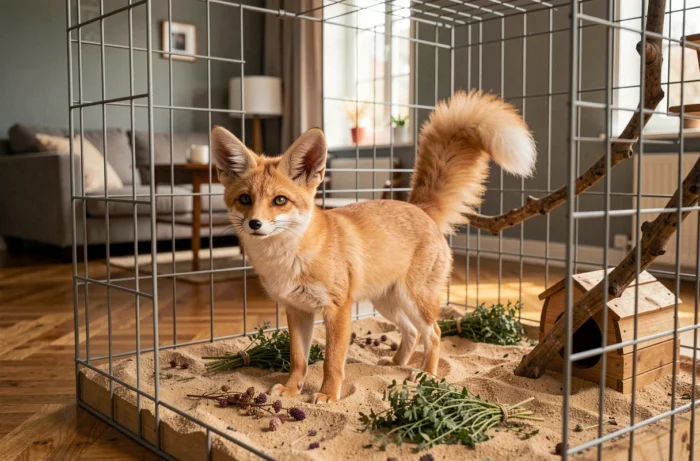
- A secure and heated outdoor enclosure is necessary, with a substrate allowing for digging (the fennec is a burrower and builds burrows several meters deep in the wild).
- The diet must replicate a varied omnivorous diet: insects, eggs, small vertebrates, fresh fruits and vegetables, without industrial dog or cat food.
- Veterinary care requires finding a practitioner specialized in wildlife, which significantly limits geographical options in France.
Finding a NAC veterinarian for fennecs in France
Medical follow-up is one of the most underestimated aspects by potential adopters. A general veterinarian trained in dogs and cats does not have the knowledge or equipment suitable for wild canids. The fennec requires a veterinarian specialized in non-domestic species, sometimes referred to as a NAC veterinarian or wildlife veterinarian.
These practitioners mainly operate in large urban areas or near zoos. In rural areas or medium-sized cities, the owner may find themselves several hours away from the nearest competent practice, which poses an obvious problem in case of emergency.
Specific pathologies to monitor
The fennec is prone to kidney issues and digestive disorders related to an inappropriate diet. Its resting heart and respiratory rates are slow compared to other small mammals, complicating diagnosis for an untrained practitioner. The absence of standardized veterinary protocols for this species makes each consultation longer and more expensive than a standard appointment.
Life expectancy and long-term commitment
A fennec lives between twelve and sixteen years in captivity. Adopting therefore commits the owner for a period comparable to that of a medium-sized dog, with significantly higher logistical constraints: the impossibility of entrusting the animal to a third party without a certificate of capacity, transportation difficulties, specific daily dietary needs.
No standard animal boarding facility accommodates fennecs. In case of relocation, separation, or changes in professional circumstances, finding a place for the animal becomes an administrative and practical headache. Facilities capable of taking in a fennec, such as Biotropica or certain specialized shelters through NGOs like AAP, are rare and often overwhelmed.
Adopting a fennec in France remains legally possible as long as one meets the certificate of capacity, prefectural authorization, CITES documents, suitable facilities, and specialized veterinary follow-up. The cumulative cost of the animal, setup, and annual maintenance far exceeds that of a typical domestic animal. The question to consider is not so much one of feasibility but of relevance, for both the animal and the owner.