Without water circulation, the disinfectant present in the pool stops being evenly distributed. A single chlorine measurement taken at the surface or near a jet no longer reflects the chemical reality of the entire volume. The question is therefore not just “how many days,” but rather: under what thermal conditions, with what treatment history, and what level of usage does the pump stop?
Disinfectant distribution without filtration pump: the real critical point
Filtration is not only used to retain particles. It ensures the homogeneous recirculation of chlorine or bromine throughout the pool’s volume. As soon as the pump stops, the disinfectant remains concentrated in the areas where it was dosed, while dead zones (bottom, corners, behind the ladder) become breeding grounds for bacterial growth.
The CDC emphasizes the importance of maintaining filtration and recirculation to ensure effective disinfection. The ARS, for its part, describes the treatment of public pools as a process of continuous filtration and disinfection. This principle also applies to private pools: without mixing, the chemical treatment loses its reliability.
Controlling pH and disinfectant levels at a single point after a prolonged shutdown gives a false sense of security. We recommend taking samples from at least three distinct areas (surface, mid-depth, bottom) before any swimming after a shutdown. As detailed in the article from La Petite Maison dans la Prairie, the tolerable duration without a pump varies greatly depending on the context.
Water temperature and algae proliferation: thresholds to know
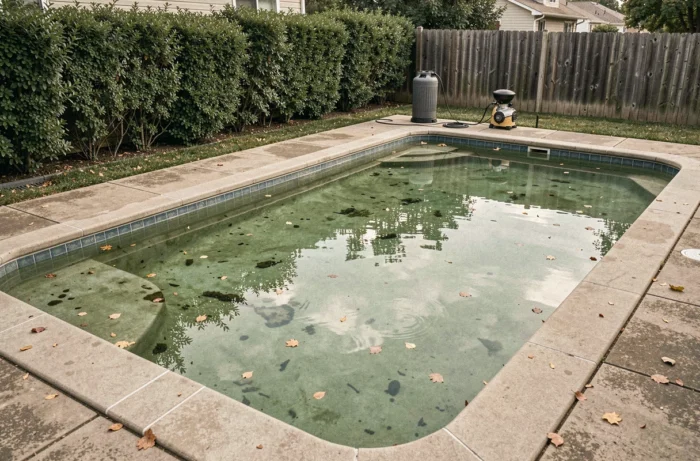
Heat is the main accelerator of biological degradation in the absence of filtration. Above around twenty degrees, microorganisms multiply much faster and consume the available free chlorine. In the height of summer, an unfiltered pool can turn in less than 48 hours if the temperature exceeds this threshold and direct sunlight is present.
Green algae are the first to colonize stagnant water. They feed on organic matter brought in by swimmers (sweat, sunscreen) and plant debris. A pool surrounded by vegetation, facing south, without a cover, constitutes the most unfavorable scenario.
Below around fifteen degrees, the kinetics change radically. Cold water slows down disinfectant consumption and algae growth. This is why passive winterization (pump completely off) works in winter, provided the chemistry has been adjusted beforehand and the pool is covered.
Aggravating factors to consider with temperature
- The recent usage of the pool: each swimmer brings organic matter that accelerates chlorine consumption, even after the pump has stopped.
- The presence of unremoved plant debris: leaves, pollen, and insects provide a nutrient substrate for algae and bacteria.
- The absence of a cover: an uncovered pool is subjected to UV rays that degrade free chlorine while receiving a continuous influx of external pollutants.
Pool without pump in summer: possible compensatory actions
Stopping the pump does not necessarily mean abandoning the pool. Certain manual actions can buy time before the water becomes irretrievable without partial draining.
Manual mixing, even rudimentary (a broom, net used in a circular motion), helps redistribute the disinfectant. This is not comparable to mechanical filtration, but it limits chemical stratification. After each mixing, a shock chlorine addition can restart disinfection throughout the volume.
Covering the pool remains the most effective action to slow degradation. The cover simultaneously reduces chlorine evaporation from UV rays, the influx of debris, and surface temperature rise. By combining a cover, daily mixing, and supplementary chlorination, a properly balanced pool can last a few extra days without active filtration, even in hot weather.
Chemicals without a pump: limits to know
Chlorine tablets, placed in a floating dispenser, dissolve slowly but do not distribute without current. Chemical treatment alone cannot replace water circulation. Phosphate removers or preventive algaecides can slow proliferation, but they do not compensate for the lack of mechanical filtration of suspended particles.
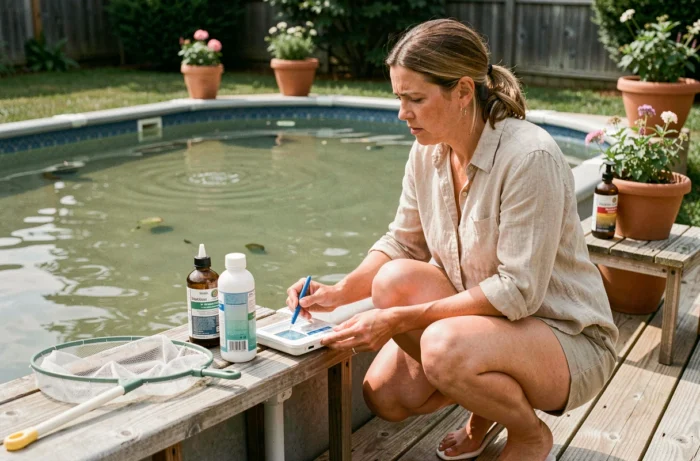
Test strips then become a daily tool. pH, free chlorine, and alkalinity must be checked every day if the pump is out of service during hot season.
Above-ground pool and small pool without filtration: a special case
Small volumes (inflatable pools, above-ground pools of a few cubic meters) react much faster to the absence of a pump. The surface/volume ratio favors rapid warming and accelerated contamination. In these pools, the water can become murky in just one summer day without any treatment or circulation.
For these installations, draining and refilling often remain the simplest and least expensive solution when the pump is unavailable for more than two days. Trying to chemically recover a small green pool sometimes consumes more products than the cost of replacement water.
Monitoring obligations for public pools
The ARS reminds us that the operator of a public pool must monitor water quality daily and ensure the proper functioning of the facilities. A pump failure in a public pool is not just a minor inconvenience: it is a non-compliance that requires closure to the public until filtration is restored and health parameters are verified.
For private pools, there is no regulatory obligation imposing a maximum duration without a pump. The limit is strictly sanitary and aesthetic. A well-prepared private pool (balanced water, cover in place, low temperature) can remain several days without a pump without irreversible consequences. However, beyond a few days in hot weather without any compensation, restoration will require shock treatment, mechanical cleaning of the bottom and walls, and potentially partial water replacement.
The “safe” duration without a pump is therefore never a fixed number. It depends on a combination of temperature, initial chemical quality, pool coverage, and external inputs. Rather than looking for a universal number of days, it is better to test the water every day and intervene as soon as the parameters drift.