
Organizing a unique and budget-friendly wedding without compromising on friendliness is possible by relying on the exchange of goods and services among close ones. Instead of multiplying service providers, this approach transforms each talent in your circle into a concrete resource for the big day.
Service exchange among close ones: the principle that changes wedding preparation
An intimate wedding naturally facilitates mutual assistance. With a tight guest list, it becomes easier to ask a photographer cousin, a florist friend, or a musician uncle for help.
The mechanism is straightforward: you identify the skills available in your circle, then propose an exchange. Does your colleague excel in pastry? She makes the wedding cake, and you help her renovate her terrace the following month. This type of agreement works because it is based on trust, not on an hourly rate.
Specialized platforms also structure these exchanges beyond the family circle. On troc-mariage.com, couples offer and seek items or assistance related to the wedding, which broadens possibilities without incurring additional costs.
Exchanging among close ones replaces entire expense categories: music, floral decoration, beauty services, transportation. A single well-negotiated exchange can represent savings of several hundred euros.
Wedding decoration items: borrow rather than buy
Decoration takes up a significant portion of the budget. Tablecloths, centerpieces, fairy lights, and ceremony arches: the list quickly grows.
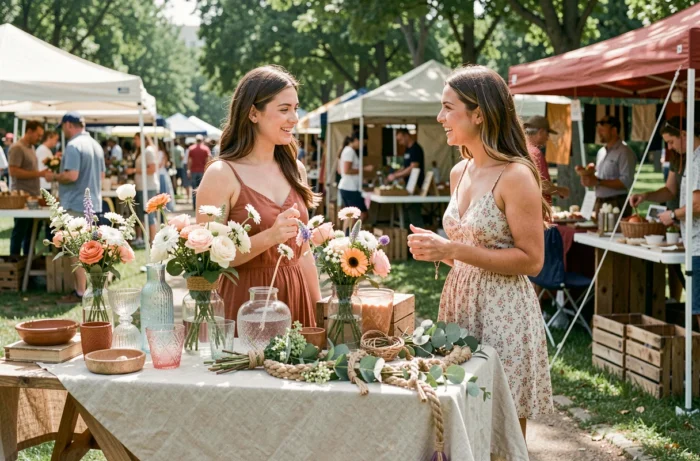
Have you thought about cataloging what is already stored in the attics of your circle? Mismatched vases, jars, lanterns, and linen tablecloths can form a solid decoration base without any new purchases.
Create a shared inventory before the celebration
Open a collaborative document (online spreadsheet, dedicated messaging group) and list the items available from each guest. This method avoids duplicates and helps identify what is genuinely missing.
- Vintage or mismatched dishes borrowed from family for the cocktail hour, more elegant than disposable sets
- Garlands, candles, and lanterns collected after other events (birthdays, year-end parties)
- Textile elements like tablecloths, table runners, or curtains lent by friends or found at recycling centers
A shared inventory eliminates most decoration purchases. What cannot be found within the circle can often be borrowed through local exchange groups or recycling centers.
Wedding budget and inflation: why bartering becomes a rational choice
The average cost of a wedding in France continues to rise. Recent inflation affects all categories, from the venue to catering and flowers.
In this context, service exchange reduces reliance on professional providers in the areas most inflated by rising prices. A buffet prepared collectively by four or five amateur cooks costs a fraction of a traditional caterer’s fee.
Areas where bartering has the most impact
Not all expense categories lend themselves equally well to exchange. Music, decoration, and photography are the three areas where amateur skills reach a sufficient level to replace a professional, provided expectations are clearly defined.
The meal remains the most challenging item to barter, but a participatory format (each family brings a signature dish, for example) transforms dinner into a moment of sharing rather than a service endured. This format works best with a modest-sized wedding, where logistics remain manageable.
Secular ceremony and reception venue: two often underestimated levers
The choice of venue concentrates a large part of the budget. Renting a venue on a Saturday during peak season represents the most expensive item for most couples.
Choosing a private garden or family land significantly reduces this cost. A friend with a large property can host the secular ceremony and meal in exchange for a future service, a gift, or simply out of friendship.
The secular ceremony, unlike the civil ceremony at the town hall, does not require an approved venue. An orchard, a farmyard, or a riverbank is sufficient. In terms of formalities, only the visit to the town hall with the couple and witnesses remains mandatory for civil registration.
Negotiate a venue in exchange for a service
Proposing a concrete exchange to a venue owner often works more than one might think. Here are some common examples:
- Mowing and maintaining the land for several months leading up to the wedding date
- Assistance with a personal project of the owner (moving, renovation, setting up a website)
- Lending specific equipment you own (trailer, sound system, DIY tools)
This type of agreement requires open discussion and a clear timeline for both parties.
Formalizing exchanges to avoid tensions on the big day
Bartering among close ones carries a risk: ambiguity. When a friend commits to playing guitar during the cocktail hour, it’s better to specify the duration, the expected repertoire, and the conditions (sound system provided or not, planned breaks).
An informal written agreement protects the relationship as much as the marriage. A simple recap message after the discussion is sufficient. It sets the terms without turning mutual assistance into a rigid contract.
For exchanges of items, photograph each borrowed piece before and after the event. This precaution avoids misunderstandings about the condition of the returned items.
Organizing a budget-friendly wedding through exchange requires more coordination than a simple checkbook, but the outcome transcends the budget question. Couples who involve their circle in the preparation often find that the celebration gains authenticity, precisely because each detail bears the mark of a real person rather than a catalog.