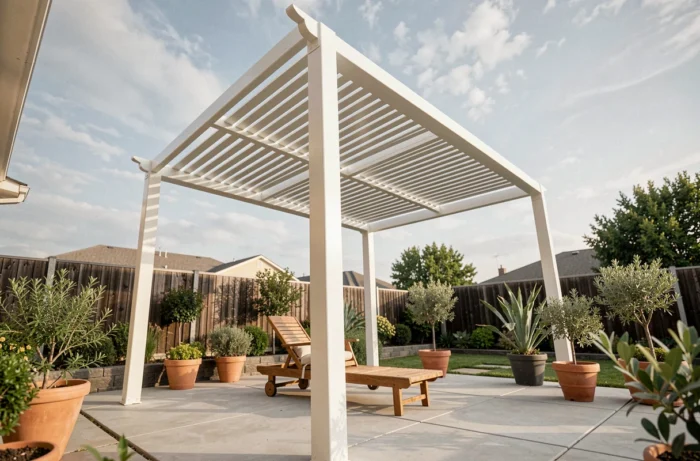
A 5-meter by 4-meter pergola covers about 20 m², which is equivalent to a living room. At this size, even the slightest design flaw can be costly: a twisting post, a fabric that sags under the rain, wood that grays in just two seasons. At Brico Dépôt, the kit offer is appealing due to its price, but durability depends on details that the label does not always highlight.
5×4 Pergola Kit: What the Box Doesn’t Tell You About Assembly
Have you ever opened a furniture kit and found screws that were too short or an offset pre-drilling? On a 20 m² pergola, this kind of approximation takes on a whole new dimension. The kits sold in large DIY stores are designed for quick assembly, often by two people, using common tools.
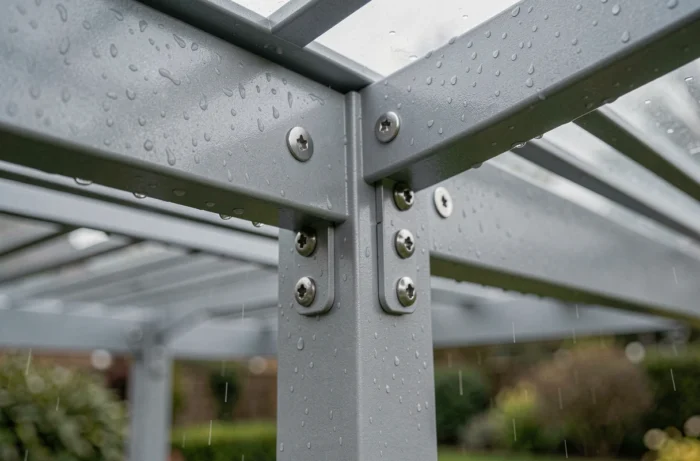
The point to check before purchasing is the quality of the hardware provided. Thin brackets, low-section bolts, lightweight mounting plates: these elements are the first to give way under the effects of wind or snow weight. Replacing the original hardware with reinforced fasteners can represent a modest additional cost, but it often makes the difference between a stable structure and a pergola that sways at the first gust of wind.
Before you start, taking the time to properly choose a 5×4 Brico Dépôt pergola means examining the assembly instructions available online. Some references display clear diagrams with integrated bracing, while others leave the steps to be inferred. A good indicator: if the instructions include diagonal braces between the posts and the beams, the structural design is more serious.
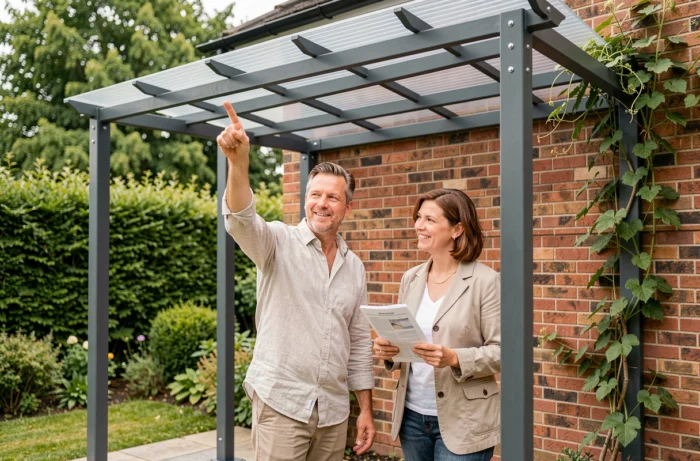
Wood or Aluminum for a 5×4 Pergola: The Real Choice to Make at Brico Dépôt
The choice of material determines everything else: maintenance, aesthetics, durability, and budget. At Brico Dépôt, the two main families available in 5×4 are wood (pressure-treated pine) and powder-coated aluminum.
Wood: Warm but Demanding
Pressure-treated pine remains the most common material for kit pergolas. The treatment involves injecting a fungicidal and insecticidal product under pressure into the fibers. What matters is the grade of the wood. For an outdoor pergola without permanent contact with the ground, class 3 is the minimum. If your posts rest on a damp slab or poorly drained ground, aim for class 4.
Wood requires regular maintenance. Without applying a saturator or stain every two to three years, graying sets in and the fibers degrade. This is a long-term commitment.
Aluminum: Lightweight and Durable, but Less Customizable
An aluminum pergola does not rust, does not warp, and only requires cleaning with soapy water. The powder-coated finish resists UV rays. In return, aluminum offers fewer customization options than wood, which can be stained, sanded, or sculpted.
For prolonged use with minimal maintenance, aluminum wins. For a natural look and the ability to modify the structure over time, wood retains the advantage.
Preliminary Declaration or Building Permit for a 5×4 Pergola
This is the point that many homeowners discover too late. A 5×4 pergola has about 20 m² of ground area. However, any structure exceeding 5 m² must at least have a preliminary declaration of works submitted to the town hall. Beyond 20 m², a building permit may be required, according to the Urban Planning Code.
With its 20 m², your pergola is precisely at the threshold between the two regimes. In practice, most cases fall under the preliminary declaration, but a permit may be required if the project is considered an extension or if the local urban plan (PLU) imposes stricter rules.
- Below 5 m² of ground area, no formalities are necessary (except in protected areas).
- Between 5 m² and 20 m², a preliminary declaration of works is sufficient in most municipalities.
- From 20 m² onwards, a building permit may be requested, especially if the pergola is attached to the house and considered an extension.
Why does this detail matter so much? Because the absence of a declaration can lead to a fine of up to 300,000 euros, according to reminders published by Pleine Vie in 2026. Some homeowners have also reported town hall inspections on pergolas they believed were “removable” and therefore exempt from formalities. If the structure remains in place for more than three months a year, the administration considers it permanent.
Covering and Options for a Durable Terrace Pergola
The structure is not everything. The choice of covering determines daily comfort and resistance to the elements.
Polycarbonate, often offered as an option at Brico Dépôt, lets light through while protecting from rain. Its limits: it yellows over time under UV effects if the quality is poor. Check that the panels have a UV-resistant treatment on the sun-exposed side.
Retractable fabrics or adjustable slats (bioclimatic pergola) offer more modularity. Adjustable slats allow you to regulate sunlight and ventilation without disassembling anything. This type of option increases the price but transforms the pergola into a true living space usable in both hot weather and light showers.
- Polycarbonate: good price/protection ratio, but check UV treatment and panel thickness.
- Retractable fabric: flexible and aesthetic, less resistant to strong winds and snow.
- Bioclimatic slats: comfort suitable all year round, higher budget and more technical assembly.
One last often-overlooked point: water management. On 20 m² of surface, a downpour generates a significant volume of water. Plan for gutters or an integrated drainage system to prevent water from running directly onto your terrace or against the facade.
Choosing a 5×4 pergola at Brico Dépôt can lead to a solid and aesthetic structure, provided you don’t stop at the displayed price. The hardware, the wood grade, the declaration at the town hall, and the type of covering form a coherent whole. Neglecting any one of these parameters weakens the entire project.