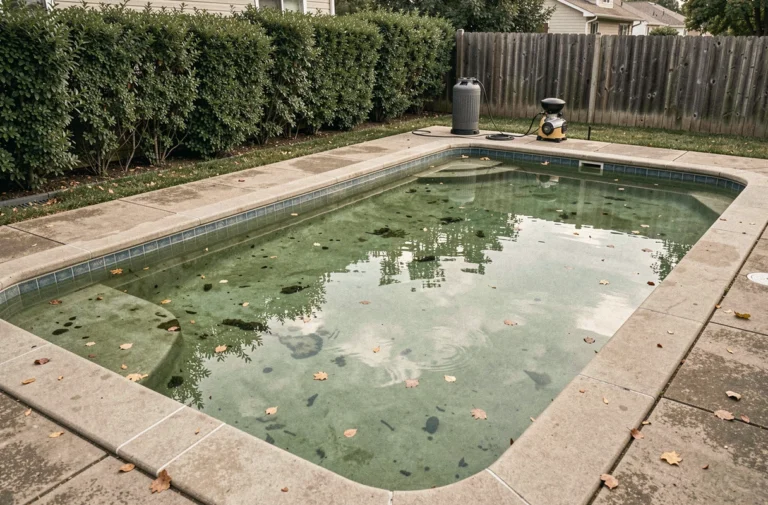
A poorly protected dwelling from solar radiation accumulates heat in its walls long before the indoor temperature becomes uncomfortable. Acting on the building envelope and air flows remains more effective than any temporary cooling device. We review the technical solutions that allow you to cool down at home without a pool, focusing on the approaches that general public guides overlook.
Thermal inertia and phase shift: the lever that walls offer for free
The ability of a wall to store coolness at night and then release it during the day depends on its thermal phase shift. A solid stone or full brick wall takes several hours to transmit outside heat indoors. A wood-frame wall insulated with dense wood fiber offers a comparable, sometimes superior phase shift.
We recommend coupling this inertia with cross-ventilation at night. Opening windows on two opposite facades creates a natural draft through the chimney effect, especially in multi-story houses. Warm air rises and escapes through the high openings while cool air enters from below.
Recent buildings designed without air conditioning exploit this principle: massive facades, external solar protections, and controlled natural ventilation.
For those looking for alternatives to cool down without a pool, this passive approach forms the foundation upon which all other solutions can be grafted.
Homemade evaporative cooling: making a mini air conditioner without a compressor

The principle is well known in climate engineering: the evaporation of water absorbs energy and lowers the ambient air temperature. Homemade evaporative mini air conditioners exploit this phenomenon with rudimentary equipment.
The method documented on Appropedia involves placing bottles of ice water in a polystyrene cooler with holes, combined with a small fan that pushes air through the cold volume. The outgoing airflow is significantly cooler than the ambient air, sufficient to cool a corner of a room or a workstation.
This device does not replace centralized air conditioning. It works as a localized supplement, relevant in homes where the installation of a split system is impossible (rental, restrictive co-ownership). Its operating cost is limited to the fan’s consumption and ice production.
Limitations to be aware of
- Efficiency drops in humid climates, as water-saturated air can no longer accept additional evaporation. In Mediterranean or dry continental areas, the gain is more pronounced.
- The cooled volume remains small: a few square meters around the air outlet. There’s no point in hoping to cool a large living room.
- Replacing the ice bottles requires logistics (freezer continuously used), which indirectly increases the household’s energy consumption.
External solar protections: awnings, pergolas, and greening
A protection placed outside the window blocks heat before it passes through the glazing. This is the fundamental difference with an interior blind, which allows infrared radiation to enter the room before attempting to reflect it.
Adjustable louvered shutters, fixed sunshades, or bioclimatic pergolas significantly reduce solar gain. Choosing light colors (white, pale yellow, light gray) for shutters and facades enhances radiation reflection.
Greening plays a complementary role. Climbing plants on a trellis in front of a south-facing facade create a living screen that combines shade and evapotranspiration. In the garden, a deciduous tree protects the house in summer while allowing light to pass through in winter.
Municipalities are increasingly mapping public cool islands (shaded parks, waterways, media libraries) to encourage residents to split their day between a protected home and a cool outdoor refuge during heat peaks.

Misting, water games in the garden, and cooling textiles
For direct bodily comfort, misting remains a low-energy consumption solution. A misting system installed on a terrace sprays fine droplets that evaporate upon contact with the skin, lowering the perceived temperature by several degrees.
In the garden, water games for children (jet mats, fun sprinklers) allow for cooling without stagnant water volume or chemical maintenance.
Phase change textiles
Bedsheets and pillows incorporating microcapsules of phase change materials (PCM) absorb body heat during sleep. Consumer media now tests these products alongside fans or misters. Their main interest: limiting nighttime awakenings due to overheating without consuming electricity.
Reducing internal heat gains: an often-overlooked angle
Turning off unnecessary electrical devices is not just an energy-saving gesture. An oven, a cooktop, a desktop computer, or a dryer emits a significant amount of heat in a closed room.
- Favor cold cooking (salads, gazpachos) or outdoor cooking (barbecue, plancha) to avoid heating the kitchen.
- Replace remaining halogen bulbs with LEDs, which convert much less energy into heat.
- Unplug chargers, consoles, and screens in standby mode, which maintain a constant thermal output even when inactive.
Combined with good management of solar protections and nighttime ventilation, this reduction of internal loads can be enough to keep a dwelling below the discomfort threshold during most heat episodes, without any active cooling system.
The choice between these different solutions depends on the type of dwelling, its exposure, and the occupant’s freedom to modify the building envelope. A tenant in a cross-ventilated apartment does not have the same levers as a homeowner with a garden. In any case, the priority is on external solar protection and nighttime ventilation, which form the technical foundation of all passive cooling.