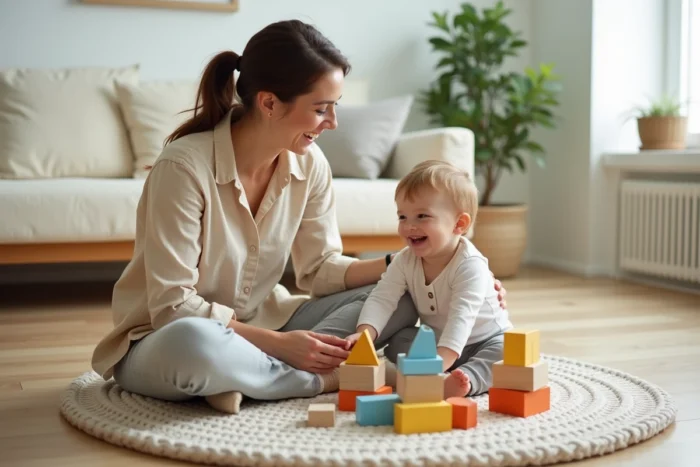
The development of a child relies on a set of fundamental needs: emotional security, sensory stimulation, opportunities for free movement, and regular verbal interactions. Supporting this development on a daily basis does not require specialized equipment or a structured program, but rather attention to ordinary moments, those when the child observes, manipulates, imitates, and tests their limits.
Screen exposure before two years and consequences on language
Syntheses published in 2023-2024 establish a strong association between regular screen exposure before the age of two and lasting impacts on language development, visual attention, and social skills. The current recommendation from experts is to avoid as much as possible any intentional screen time before the age of two, even in the presence of an adult.
This tightening of warnings does not mean that screens are toxic in themselves. The issue lies in the time they replace: every minute spent in front of video content is a minute without manipulating objects, without verbal exchange, without motor exploration. For a brain in the midst of neural construction, these concrete activities provide sensory feedback that screens cannot replicate.
The documented trend is to favor outdoor play, non-digital toys, and contact with nature as compensatory measures. Allowing a child to dig in the dirt, stack stones, or observe insects simultaneously engages fine motor skills, descriptive vocabulary, and emotional regulation. You will also find information on Conseils Parentaux child that details these approaches by age group.
Daily routines and the child’s emotional security
Predictability is reassuring. A child who knows what will happen after bath time or before bedtime expends less energy managing uncertainty and dedicates more to exploring, learning, and interacting. The routine is not a rigid framework: it is a guiding thread that provides the child with stable temporal landmarks.
Three moments of daily life particularly lend themselves to active support of development:
- Meal times, where the child can participate in age-appropriate preparation (washing a vegetable, pouring water), which works on fine motor skills and vocabulary related to food, textures, and temperatures.
- Bath time, which offers a rich sensory space (warm water, foam, floating objects) conducive to free experimentation and verbal exchanges in a relaxed context.
- Bedtime, when a short story read aloud or a song repeated every night strengthens the emotional bond while consolidating narrative structures and passive vocabulary.
Transforming daily care into learning opportunities does not require extra time. Naming actions during diaper changes, describing the clothes being put on, counting the steps of the staircase: these micro-language interactions accumulate and form the foundation of verbal development.
Child autonomy: calibrating tasks according to age
Autonomy is not decreed; it is built in stages. Proposing a task that is too complex generates frustration. Proposing a task that is too simple is boring. The right calibration relies on observation: when the child begins to imitate an action spontaneously, they are ready to try it with minimal support.
Before the age of three, putting a toy in a bin, placing a sock in the laundry basket, or wiping a table with a damp sponge are realistic tasks. The goal is not the result (the table will likely remain wet) but the process: the child experiences their ability to act on their environment.
Between three and six years old, the possibilities expand. Setting the table, watering a plant, folding a cloth. Each completed task reinforces the sense of competence. Two precautions to keep in mind: do not redo the task in front of the child (which nullifies the positive effect) and accept that the pace may be slow.
Child’s emotions: supporting without minimizing
A child who cries because their block tower has fallen experiences real frustration. The temptation to say “it’s nothing” is strong, but this response invalidates the emotion felt. Naming the emotion the child is experiencing helps them recognize it and, gradually, to regulate it themselves.
“You are angry because your tower has fallen” is a simple phrase that serves three functions: it validates the feeling, it provides emotional vocabulary, and it shows the child that an adult understands what they are going through. This approach, documented in the works on positive discipline cited by UNICEF, is based on a clear principle: there are no bad emotions, only behaviors to support.
The physical environment also plays a role. A calm space where the child can retreat when emotions overflow (a cushion in a corner, a soft blanket) offers them a concrete alternative to the crisis. This is not a punishment; it is a tool for emotional regulation accessible from the age of two.
Free play and creativity: fewer instructions, more exploration
Adult-directed play has its place, but free play, where the child chooses the activity, the pace, and the rules, stimulates different skills. Creativity, problem-solving, and decision-making develop when the child does not wait for instructions.
Several conditions favor this free play:
- A safe space where the child can move, climb, or sit on the floor without constant adult intervention.
- Simple and versatile objects (cardboard, fabrics, bowls, wooden spoons) rather than single-function toys that dictate how to use them.
- Periods without external stimulation, no background music or screens on, so the child learns to occupy themselves and tolerate boredom.
Boredom is a trigger for creativity, not a problem to solve. A bored child eventually invents an activity, and this personal initiative has more developmental value than an hour of structured activity.
Supporting a child’s development on a daily basis means protecting these spaces of freedom while maintaining a predictable framework. The most effective gestures are often the least spectacular: talking during care, allowing the child to try before intervening, naming their emotions aloud. It is these discreet repetitions, day after day, that build the foundations.