
When making an online purchase, the payment form asks you to fill in a field “MM/YY”. Sometimes we hesitate for a second too long, we swap the numbers, and the transaction fails. This MM YY code corresponds to the expiration date of your credit card, expressed in month followed by year. Two pairs of digits, engraved or printed on the plastic, that determine each remote payment.
Credit card without visible number: MM YY remains essential on the system side
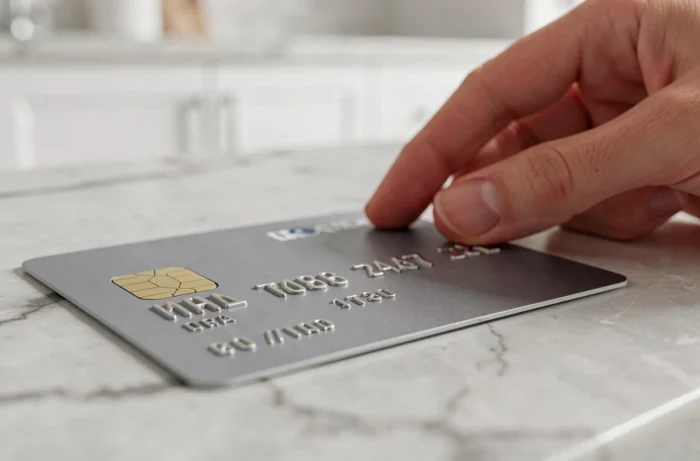
Several manufacturers, including IDEMIA, are developing so-called “numberless” cards where neither the number, nor the expiration date, nor the CVV appear on the plastic. The goal is to reduce data theft at a glance, in-store or from a stolen photo.
For the cardholder, this changes the habit: you no longer flip the card to read the numbers before an online purchase. The MM/YY and the rest of the information are then only accessible in the banking app or via NFC. You can learn everything about the mm yy code and its format variations to avoid getting stuck in front of a form.
On the technical side, nothing changes. The month/year pair remains a mandatory parameter in the payment authorization protocol. Whether the card is printed or blank, the system requires this data to validate the transaction. The visual disappearance of the code does not eliminate its role in the verification chain.

MM YY and 3-D Secure: how the expiration date influences risk scoring
The expiration date is rarely associated with the active security of a transaction. It seems passive, a simple binary filter (valid or expired). Recent versions of 3-D Secure show that it is more nuanced.
The scoring engines that decide whether a payment goes into “frictionless” mode (without customer action) or “challenge” mode (SMS code, biometric validation) analyze several criteria: device used, purchase history, location, amount. Among these signals, the validity of the card and its age are taken into account.
A recently renewed card, with a fresh MM/YY, may be treated differently than a card that has been in circulation for several years. The system assesses the risk of fraud by cross-referencing this data with other parameters. Specifically, if you just received a new card and make a large purchase from an unknown device, the likelihood of enhanced authentication increases.
Frictionless or challenge: what happens in the background
The 3-D Secure protocol decides in milliseconds the level of verification. Here are the main criteria combined with the MM/YY in this evaluation:
- The device and browser used for payment, compared to the cardholder’s history
- The transaction amount relative to recorded spending habits
- The geographical location at the time of purchase, cross-referenced with the card’s issuing country
- The age of the card (deduced from the MM/YY) and the date of its last renewal
The MM/YY is therefore not just a simple access key. It feeds an algorithm that protects the cardholder in real time.
Format MM YY, MM YYYY, MM-YY: untangling the variants on payment forms
Not all merchant sites present the field in the same way. You may encounter “MM/YY”, “MM/YYYY”, “MM-YY”, or even “Month/Year” spelled out. This diversity creates confusion, especially when you don’t know if “YY” expects two or four digits for the year.
MM always refers to the month in two digits, from 01 (January) to 12 (December). For the year, “YY” or “YY” requires the last two digits (for example, 26 for 2026), while “YYYY” expects the full year (2026). The data is identical; only the formatting changes.
Common mistakes that block payment
An incorrectly entered expiration date is the main cause of transaction failure, even before an error on the card number. A few recurring traps deserve to be highlighted:
- Swapping month and year: typing 26/09 instead of 09/26 (a reflex related to the French date format day/month)
- Entering four digits for the year in a field that only expects two, or vice versa
- Using the current date instead of the date printed on the card when filling out the form from memory
On “numberless” cards, these errors become more frequent since you have to switch to the app to retrieve the information. Checking the expected format by the form before entering avoids the majority of refusals.
Card renewal and continuity of recurring payments
An online subscription (streaming, cloud, press) records the card number, CVV, and MM/YY at the time of subscription. When the card expires and a new one arrives, these three data points change. If you do not update your information, the next charge fails.
Some banks offer an automatic data update mechanism with partner merchants. The Visa or Mastercard network then transmits the new MM/YY (and sometimes the new number) directly to the merchant, without the cardholder’s intervention. Feedback varies on this point: not all merchants are compatible with this service, and some subscriptions still require manual entry.
Listing your active subscriptions before the card expires remains the most reliable method. You identify the services to update, modify the MM/YY as soon as you receive the new card, and avoid service interruptions or reminder fees.
The MM YY code may seem trivial on the plastic or in the banking app. In practice, it is involved in every payment authorization, influences the level of security applied by 3-D Secure, and conditions the continuity of all recurring charges. Two pairs of digits that deserve to be known where to find them and how to enter them correctly.