
The certified true copy of an original no longer concerns, in the vast majority of cases, the internal procedures of French administrations. Since the decree of October 1, 2001, a readable copy is sufficient for any exchange with an administration on the territory. However, the procedure remains fully active as soon as a French administrative document must be produced before a foreign authority or a private organization that requires it.
Apostille and legalization from 2025: what changes for the certified true copy
The certified true copy is just a first step when the document needs to circulate internationally. Since May 1, 2025, requests for apostille and legalization fall under the regional notary councils or interdepartmental chambers of notaries, and no longer under the Ministry of Foreign Affairs.
This reorganization has direct consequences on the applicant’s journey. The certified true copy is still issued by the town hall of your place of residence or by the consulate, but the next step of the process (authentication of the origin of the act) now goes through a notarial circuit.
We recommend checking with the competent chamber whether the certified true document also needs to undergo an apostille or legalization, as the two procedures are distinct. The apostille applies to countries that are signatories to the Hague Convention, while legalization applies to others. Confusing the two prolongs processing times.
Knowing how to certify a copy as true to the original remains a necessary prerequisite before any request for apostille or legalization.
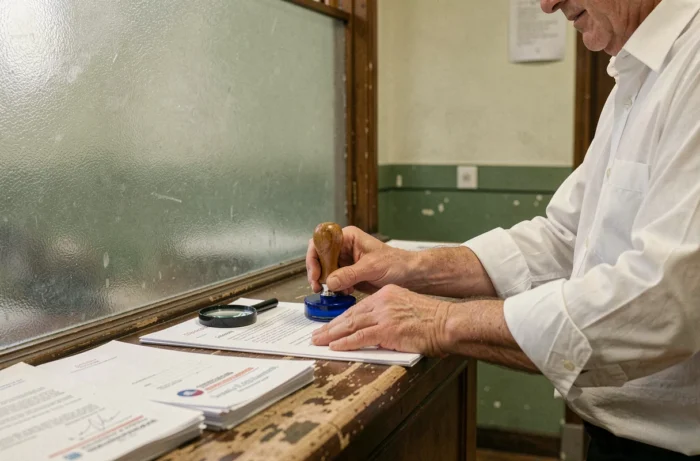
Certified true copy at the town hall: accepted documents and common refusals
Only documents issued by a French administration can be certified true by a town hall or consulate. A foreign diploma, a private contract drafted abroad, or a non-administrative private deed do not fall under this procedure.
The most common refusals concern specific categories:
- Copies of civil status documents (birth, marriage, death): you must contact the town hall or the Central Civil Status Service in Nantes directly to obtain a full copy or an extract.
- Copies of judgments: only the registry of the court that issued the decision can provide an authentic copy.
- Documents whose original is unreadable, damaged, or whose photocopy does not faithfully reproduce the content (cross-outs, truncated marginal notes).
When submitting at the town hall, the applicant must present the original document, a photocopy of it, and an identity document. The recipient country must be specified: the municipality includes it on the certified copy. Without this indication, the certification may be refused or deemed incomplete by the foreign authority.
Material requirements for a certified true copy
The reproduction must be literal: no resolution of abbreviations, respect for the original spelling, no omissions, overloading, or additions in the body of the text.
These requirements explain why certification can only be performed by the service that holds the original document, or by an authorized authority that physically compares it to the copy. A photocopy made at home and then brought to the town hall meets these criteria as long as it is complete, readable, and faithful.
Digital copy and certified true copy
No text currently provides a procedure for certifying a true copy for a fully dematerialized document produced in the form of a scan. Certification requires the physical presentation of the original. A scan sent by email cannot be certified true by a town hall.
The qualified electronic signature, which offers a level of guarantee comparable to a handwritten signature, does not replace the certified true copy. These are two different legal mechanisms: the electronic signature attests to the identity of the signer and the integrity of the file, while the certified true copy attests to the fidelity of a copy to a paper original.

Certified true copy for a passport or identity card intended for abroad
Requests for certified true copies frequently concern passports and identity cards, particularly in the context of immigration procedures, university enrollment abroad, or business creation outside French territory.
The procedure is identical to that for other administrative documents: presentation of the original and the photocopy at the town hall or consulate, with indication of the recipient country. We observe that some consulates require a specific form in addition.
A point of caution: if the foreign authority requests a valid passport, the certified copy of an expired document will not meet its requirement.
For French citizens residing abroad, the competent consulate can carry out the certification. This service is chargeable within the consular network.