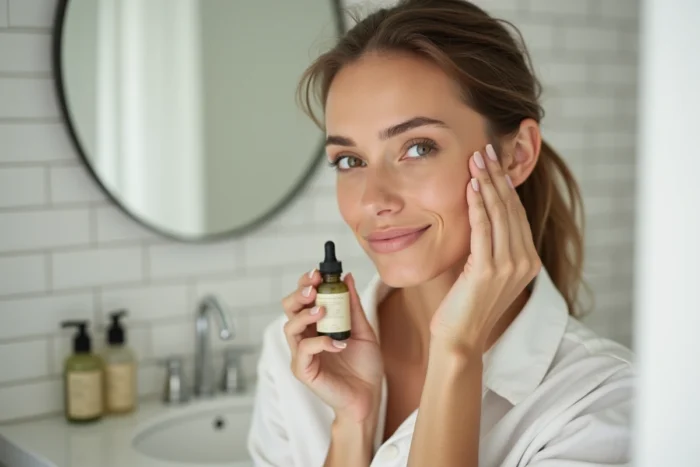
Typology has claimed since its creation in 2019 a direct sales model, without intermediaries. The brand founded by Ning Li has built its online reputation with short formulas and recognizable amber bottles. The question of its presence at Sephora comes up regularly in searches, but the reality of this distribution deserves careful examination.
Typology and the direct-to-consumer model: what it changes for distribution
Typology has built itself on a short circuit. The official website remains the main channel, with an online skin diagnosis that directs to targeted references. This positioning is not trivial: it allows the brand to control its margins, customer data, and product messaging.
Several analyses of the cosmetic market in 2026 confirm that Typology is not listed as a brand distributed by Sephora, neither in physical stores nor on the brand’s marketplace. Search results associating the two names often come from editorial or comparative content, not from an established commercial partnership.
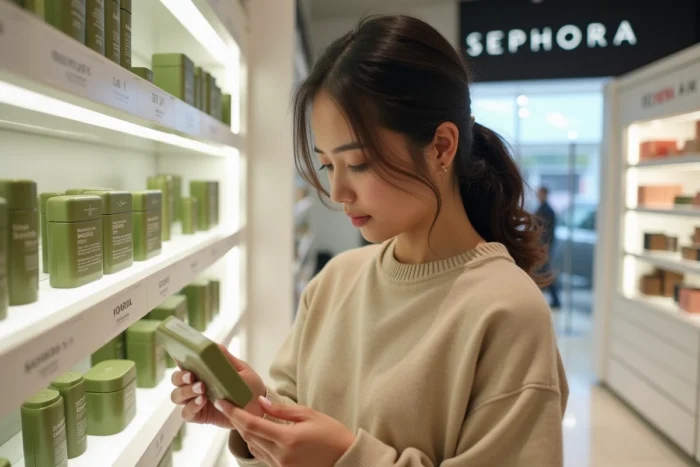
For those wishing to delve deeper into this subject, the Typology range at Sephora is the subject of a detailed file that places this question in context. The direct-to-consumer model adopted by Typology is closer to that of other French digital brands than to the traditional selective circuit in which Sephora operates.
Short formulas and displayed actives: the Typology promise against in-store expectations
Typology’s approach is based on formulas containing few ingredients, with a clearly indicated concentration of actives on each bottle. The vitamin C glow serum, the face cream with nine ingredients, or the tinted serum are among the most cited references in online reviews.
This transparency about composition responds to an underlying trend. Consumers are increasingly consulting application scores like Yuka before making a purchase. According to available data, a majority of Typology products receive high scores on this type of platform.
On the other hand, field feedback varies on sensitized skin. Several users report irritations, particularly with serums containing acids or concentrated vitamin C. Minimalist formulas do not automatically mean better tolerance for all skin types.
What we find in the best-sellers
- The tinted serum with vitamin C and aloe vera, positioned as a hybrid skincare-makeup suitable for quick routines
- The face cream with nine ingredients, often cited for its lightweight texture and its list of actives reduced to the bare essentials
- The glow serum combining vitamin C and vitamin E, which targets dull complexion issues and lack of uniformity
These products share a common point: prices positioned below the average of selective skincare. This pricing strategy makes the brand accessible, but also complicates its entry into distribution networks that operate with different margins.
New allergen regulation 2026: a challenge for Typology and its sales channels
A European regulatory change will modify the marketing conditions for many cosmetics in France. Regulation (EU) 2023/1545, applicable from July 31, 2026, expands the list of fragrance allergens to be declared on labeling.
For a brand like Typology, which uses plant extracts in certain formulations (essential oils, botanical actives), this obligation implies an update of packaging. Compliance with this new framework conditions sales in any distribution point within European territory.
This constraint weighs on brands considering expanding their sales network. A distributor like Sephora, subject to strict compliance audits, would not accept to list products whose labeling is not perfectly aligned with current regulations. Regulatory compliance is a prerequisite before any listing discussion.
What the regulation changes concretely
The list of fragrance allergens subject to declaration increases from about twenty to several dozen substances. Brands must not only adjust their labels but also review their product information files (PIF). For formulas containing complex natural extracts, identifying each potential allergen represents a significant analytical task.
Buying Typology in 2026: physical sales points and alternatives
Typology has opened its own stores, mainly in Paris, with gradual expansion into other regions. These spaces allow testing of textures and shades, a step that the online channel cannot replace for certain products like the tinted serum.
Outside of these own stores, physical distribution remains very limited. The brand is not systematically present in pharmacies, parapharmacies, or department stores. The official website remains the channel where the entire catalog is accessible, with the skin diagnosis as a guiding tool.
- Typology own stores: product testing possible, limited catalog compared to the website
- Official website: full access to the catalog, online diagnosis, direct delivery
- Marketplace and third-party resellers: occasional presence but not guaranteed, caution on expiration dates
The available data does not allow for a conclusion regarding imminent listing at Sephora or other selective retailers. Typology’s business model, based on direct margin and customer relationship without intermediaries, does not naturally align with the usual conditions of selective distribution. The brand could evolve on this point, but no public signal suggests this direction as of the writing of this article.