The outdoor storage box has long been treated as a utilitarian accessory, a simple container placed in a corner of the terrace. The available online content focuses on materials and volumes, without addressing the question that now arises: how can a box contribute to the overall aesthetics of a garden without sacrificing its storage function?
Garden box and UV resistance: an underestimated technical criterion
Classic buying guides mention weather resistance (rain, frost) as the main criterion. Field feedback varies on this point: it is often prolonged exposure to UV rays and summer heat spikes that degrade an outdoor box the fastest.
A low-end resin box exposed full south can fade in just one season. The fittings soften, the lid warps, and the hinges lose their tension. Recent models incorporate anti-UV treatments within the material, rather than just a superficial layer, which radically changes longevity.
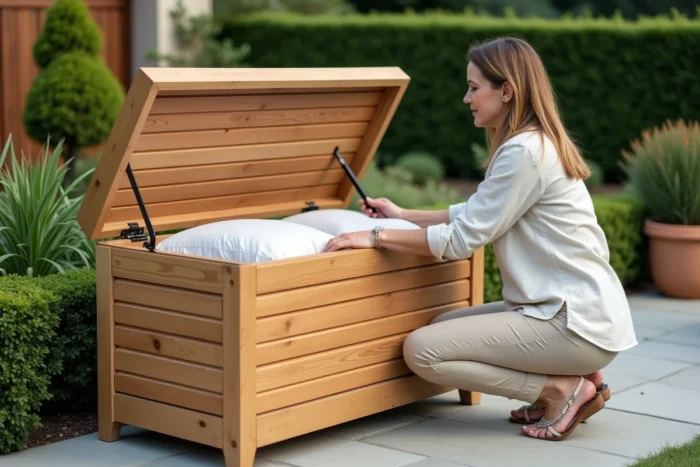
For wooden boxes, the problem is different: UV rays dry out the fibers and cause graying that is not just aesthetic. Without appropriate protection (oil, saturator), the wood also loses its mechanical strength. Choosing an outdoor storage box from Brico Dépôt allows for a comparison of ranges in treated resin and wood, with technical sheets that specify the type of UV protection.
The gas struts on the lid, often presented as a comfort detail, also play a safety role: they prevent the lid from falling due to thermal expansion. A quality strut withstands temperature variations better than a simple friction hinge.
Outdoor decor trends: the outdoor box as a style element
The terrace and patio trends in 2026 mark a clear break from the total gray look that has dominated for several years. The palettes are shifting towards organic tones: deep greens, sandy beiges, desaturated terracotta, mineral blues. Shapes are becoming rounder, and textures mimic less industrial smoothness and more weaving or raw wood.
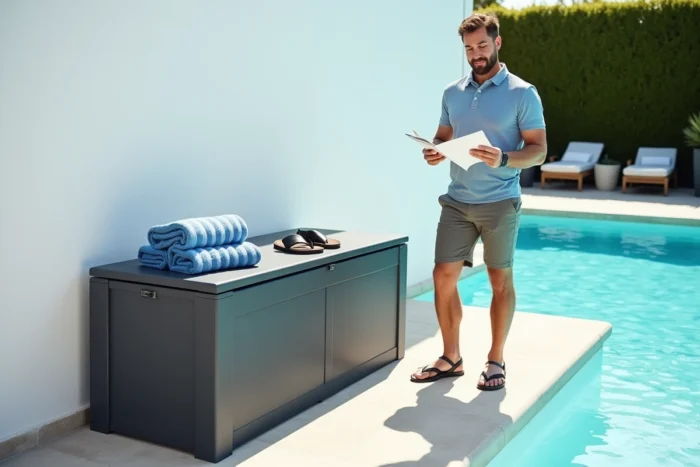
This movement, well documented for garden lounges and pergolas, is almost never linked to the choice of storage box. An anthracite gray rectangular box placed next to a natural rattan lounge with curved lines creates a visual break that dates the whole.
Organic materials and curved shapes for the box
The return of organic materials (wood, rattan, quality woven resin) offers options that did not exist a few years ago for boxes. Some manufacturers now offer boxes whose resin faithfully reproduces the appearance of woven rattan, with colors that integrate into natural palettes.
The choice of color deserves as much attention as the choice of material. A box in a sandy or light wood tone visually ages better than a black or dark gray box, which shows dust, pollen, and micro-scratches more prominently.
Bench box or coffee table box: the dual function
A box that also serves as seating or a side table justifies its presence on a terrace more easily. The constraint is technical: the lid must support static weight without bending. Models designed from the outset as bench-boxes incorporate structural reinforcement under the top that classic boxes do not have.
Also check the seating height if you plan to use it as a bench. A standard box is often too low for comfortable seating, limiting its actual use to disguised storage.
Resin, wood, or metal: what product sheets don’t say
Existing comparisons list the advantages and disadvantages of each material. Here’s what they often overlook.
- Quality resin is distinguished by its wall thickness: a box made of thin resin (thin wall) resonates when touched, deforms under heat, and inspires little confidence in terms of safety. A thick wall with a honeycomb structure offers rigidity comparable to wood.
- Wood requires annual maintenance (oil or saturator), but offers a breathability that resin and metal do not have. To store cushions or textiles, a wooden box reduces the risk of internal condensation and thus mold.
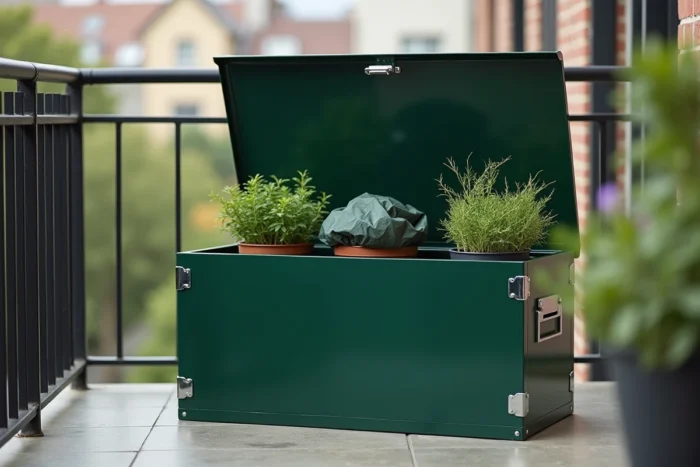
- Metal (galvanized steel, aluminum) is mechanically durable but heats up significantly in the sun. A metal box exposed in the full summer can reach temperatures that damage stored items inside, particularly soft plastics and synthetic textiles.
The choice of material therefore depends less on an objective ranking than on the intended use and location. A box in the shade of a pergola does not have the same constraints as a box in full sun near a pool.
Storage volume and location: common mistakes
The temptation is to choose the largest possible volume. In practice, an oversized box ends up serving as a dumping ground rather than organized storage. It’s better to have two medium-sized boxes, placed strategically (one near the lounge, one near the shed or vegetable garden), than one massive box relegated to the back of the garden.
Before purchasing, measure the available space considering the lid’s opening. A box placed against a wall or under a window sill needs sufficient vertical clearance. Some models offer front or side openings that solve this problem, but they remain in the minority on the market.
- List what you actually plan to store: lounge cushions, gardening tools, toys, pool accessories.
- Estimate the necessary volume by stacking these items before ordering.
- Allow for circulation space around the box for easy access to the contents.
A lockable box adds a valuable layer of security if you store small tools or cleaning products. Built-in locks are preferable to padlocks added later, which often weaken the attachment point.
The outdoor storage box deserves to be chosen with the same care as the rest of the garden furniture. A material suited to the actual exposure of the box and a color in tune with the terrace ambiance will make the difference between an accessory that blends into the decor and a utilitarian block that is ultimately ignored.