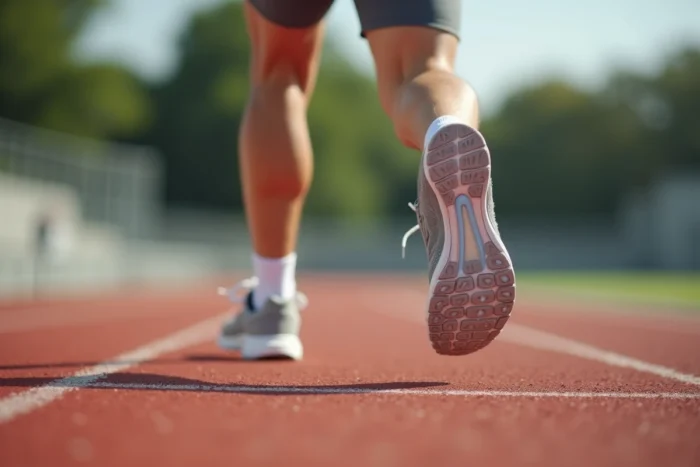
Pronation and supination describe two opposing rotations of the foot (or forearm) that directly influence the quality of a workout. Understanding what distinguishes these two movements allows for the adaptation of running shoes, weightlifting grips, and limits joint compensations that can lead to medium-term injuries.
Foot Pronation and Supination: Comparative Table of Mechanics
The confusion between pronation and supination often arises from the fact that both movements occur with each stride. However, their roles differ significantly depending on the phase of the walking or running cycle.
| Criterion | Pronation | Supination |
|---|---|---|
| Direction of rotation | Foot rolls inward | Foot rolls outward |
| Weight distribution | Load on the inner edge | Load on the outer edge |
| Dominant phase of the stride | Landing and cushioning | Propulsion and push-off |
| Typical wear zone of the sole | Inner edge of the forefoot | Outer edge of the heel to the forefoot |
| Risks in case of excess | Strain on the knee and arch | Tibial periostitis, ankle sprain |
A moderate movement of pronation is normal and even protective: it absorbs the impact of landing. Supination then comes into play to stiffen the foot and generate push-off. The problem arises when one of the two movements overwhelmingly dominates the other, concentrating stresses on structures not designed to handle them alone.
Diving deeper into the difference between pronation and supination helps establish a reliable stride diagnosis before making any changes to one’s equipment.
Over-Correction of Stride: An Underestimated Trap in Training
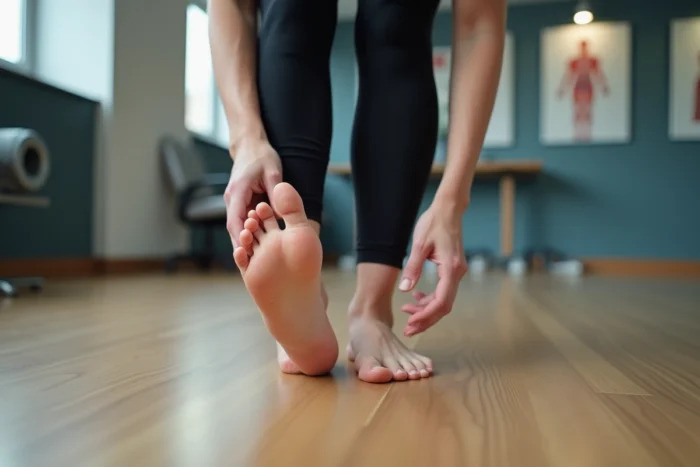
Classic content on pronation and supination often stops at shoe choice. Pronation stride, therefore, motion control shoe. Supination stride, hence, cushioned and flexible model. This linear reasoning presents a concrete problem.
Field reports show that over-correction can shift stresses to the knee or hip in runners who had no prior pathology. In other words, correcting a slight pronation with a very rigid device does not eliminate the mechanical load: it transfers it higher up the joint chain.
This is a point that beginner runners almost systematically overlook. A slight pronation in an asymptomatic runner does not necessarily require intervention. Natural pronation contributes to cushioning. Completely neutralizing it amounts to depriving the foot of its primary absorption mechanism.
How to Assess if a Correction is Necessary
- Observe the wear of your soles on at least two pairs of regularly worn shoes to identify a recurring pattern rather than a one-off stride accident
- Monitor the onset of morning stiffness in the heel, arch, or knee, signs that the structures are compensating beyond their capacity
- Consult a sports podiatrist or physiotherapist for a dynamic analysis of the stride on an instrumented treadmill, rather than relying solely on the worn sole test
A static test in-store is not sufficient to determine the actual behavior of the foot while running. The stride changes with fatigue, speed, and elevation.
Thick Foam Shoes and Distorted Perception of Stride
The rise of shoes with very thick soft foam soles (the “super shoes” that have appeared massively in recent years) has added a variable that classic choice guides do not incorporate.
In specialized stores, tests reveal that very thick and highly cushioned foam can mask the sensations of slight pronation or supination. The runner no longer perceives the warning signals (stiffness upon rising, tibial tension) indicating that their structures are compensating excessively.
On the other hand, models closer to the ground or minimalist offer a more direct reading of foot mechanics. The runner immediately feels if their support drifts inward or outward, allowing for a natural adjustment of the stride.
This does not mean that thick foam shoes should be avoided. Their role in road performance is documented. The problem arises especially for runners looking to identify their stride type: doing so with a highly cushioned shoe is akin to measuring a signal through a thick filter.
Pronation and Supination in Weightlifting: Grip and Muscle Recruitment
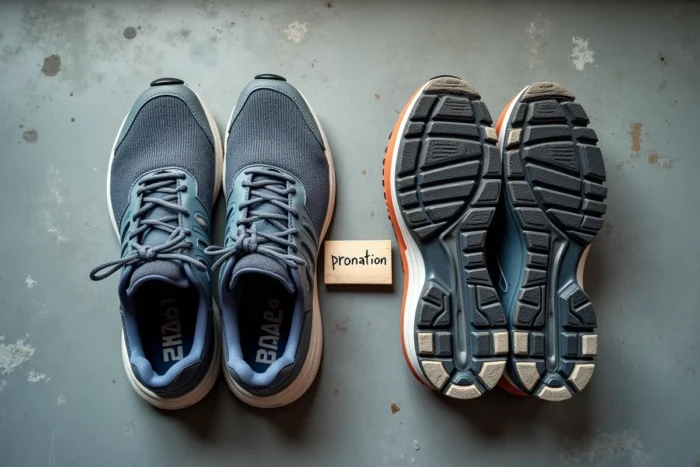
Pronation and supination are not only related to the foot. In weightlifting, these terms refer to the rotation of the forearm, and the choice of grip profoundly alters the muscle recruitment of the same exercise.
In a supinated grip (palms up), the biceps brachii is engaged in its fullest range. This is the classic position for the curl. In a pronated grip (palms down), the brachioradialis and pronator teres take over, while the contribution of the biceps decreases.
Applying This Logic to Back Training
Pull-ups in supination target the biceps and lower latissimus dorsi more, while pull-ups in pronation distribute the load across the entire latissimus dorsi and engage the teres major more strongly. Alternating the two grips over sessions allows for balanced back development without multiplying exercises.
A technical detail often overlooked: grip width interacts with forearm rotation. A very wide supinated grip places the wrist in a constraining position that can generate pain at the medial epicondyle. Supination is better associated with a narrow or shoulder-width grip to preserve the elbow joint.
- Supinated bar curl: maximal recruitment of the biceps brachii, to be prioritized at the beginning of arm sessions
- Pronated bar curl (reverse curl): targets the brachioradialis and forearm extensors, useful for balancing development
- Narrow supinated pull-up: more biceps engaged, lower latissimus dorsi
- Wide pronated pull-up: overall latissimus dorsi, teres major, less biceps
Whether for running or weightlifting, the distinction between pronation and supination is not a mere anatomical detail. It conditions the distribution of loads across the entire musculoskeletal chain. Identifying one’s movement pattern, without over-correcting it, remains the most direct lever for progressing without accumulating compensations.