
Homemade dry shampoo is based on a simple principle: absorbent powders capture sebum at the roots, restore volume, and extend the interval between two washes with water. Most recipes available online are similar, featuring the same lists of ingredients and the same promises.
What is often lacking is a critical reading of what these powders actually do to the scalp, the limitations of the term “natural,” and the necessary adjustments based on hair color or type.
Absorbent powders and the scalp: what dry shampoo really does to the roots
The mechanism of a dry shampoo, whether industrial or homemade, is purely mechanical. The powder (cornstarch, arrowroot, clay) settles on the hair fiber and absorbs excess sebum by capillarity. The hair appears cleaner and lighter. However, none of these powders cleanses the scalp in the dermatological sense of the term.
The accumulation of powder residues on the scalp, especially with frequent use, can clog hair follicles. Field reports vary on this point: some people use it several times a week without irritation, while others experience itching after just the second application. Individual scalp sensitivity remains the determining factor.
Baking soda, often recommended as a base ingredient, deserves special attention. Its pH is significantly more alkaline than that of the scalp. Used pure or in excess, baking soda can dry out and irritate the roots.
If you are following a natural homemade dry shampoo recipe, limiting the proportion of baking soda to a minor fraction of the total mixture is safer than the high dosages sometimes suggested.
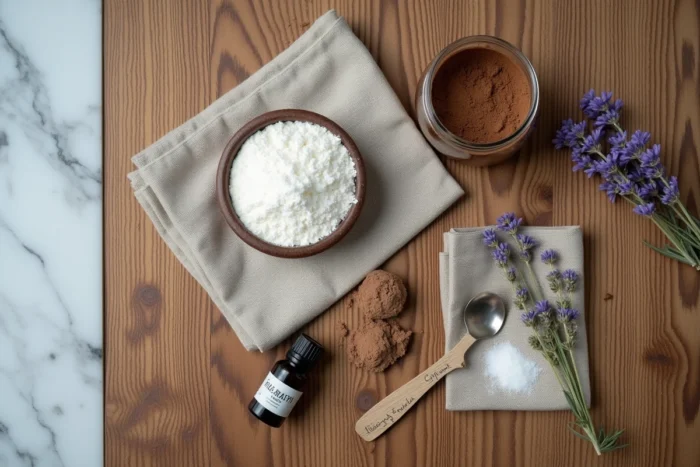
Starch, clay, or arrowroot: choosing the right powder for your homemade dry shampoo
Not all absorbent powders are created equal. The choice depends on your hair type, color, and the intended frequency of use.
Cornstarch and arrowroot
These are the most common bases. Their absorbent power is high, and their fine texture makes application easier. The main problem: they leave a visible white film, sometimes stubborn, on dark hair. Arrowroot tends to be slightly finer than cornstarch, which reduces the “powdered wig” effect without completely eliminating it on brown or black hair.
White clay (kaolin) and rhassoul
White clay absorbs sebum while better respecting the pH of the scalp than baking soda. Rhassoul, a Moroccan clay, has the advantage of being naturally darker, making it suitable for light to dark brown hair. Professional brands have recently developed tinted dry shampoos based on rhassoul and lignin to avoid white residues on dark hair.
Unsweetened cocoa powder
Added to the mixture for brown hair, cocoa colors the powder and masks white traces. Its own absorbent power is limited; it primarily serves as a natural dye. For red hair, cinnamon serves the same purpose.
- Blonde or white hair: cornstarch or arrowroot alone, possibly with a hint of white clay
- Light to dark brown hair: cornstarch base mixed with unsweetened cocoa or rhassoul, in equal proportions
- Black hair: rhassoul as the main base, complemented by activated charcoal in very small amounts
- Red hair: cornstarch with powdered cinnamon, adjusting the shade gradually
Natural dry shampoo recipe: formulation and concrete proportions
The base of a homemade dry shampoo consists of three categories of ingredients: an absorbent powder, a color adjuster, and an optional complementary active ingredient.
For a jar of about four to six uses, mix two tablespoons of starch (corn or arrowroot) with one tablespoon of white clay. If your hair is dark, replace half of the starch with unsweetened cocoa or rhassoul. Add half a teaspoon of baking soda, no more.
To scent the mixture, two to three drops of essential oil are sufficient. Lavender and tea tree are often mentioned for their purifying properties. However, check for any allergic reaction on a small area of skin before applying it to the scalp, as some essential oils are declared allergens even in natural cosmetics.

Application: technique and common mistakes
Take a small amount of powder with your fingertips or a wide makeup brush. Apply directly to the roots, separating the strands. Let it sit for two to three minutes for the powder to absorb the sebum, then brush vigorously upside down to remove the excess.
The most common mistake is applying too much. An excess of powder weighs down the roots instead of lightening them and creates a visible deposit, even on light hair. It’s better to do two light applications than one thick layer.
- Never apply to wet or damp hair, as this can create a sticky paste
- Store the mixture in an airtight container, away from moisture, to prevent the powder from clumping
- Limit use to two or three consecutive days before a proper wash with water
“Natural” label: what it guarantees (and what it does not guarantee)
A dry shampoo made at home with cornstarch and clay can legitimately be called natural. However, French cosmetic regulations do not provide a strict legal definition for the term “natural.” The label “natural” does not guarantee the safety or effectiveness of the product. Only the label “organic” requires that the ingredients come from organic farming.
This means that a natural ingredient can perfectly cause irritation or an allergy. Clay, baking soda, essential oils: all have an irritating potential depending on the skin. Making your own dry shampoo does not exempt you from testing each ingredient, especially on a sensitive scalp or one prone to dandruff.
The global hair care market is experiencing strong growth driven by the demand for natural products. This trend encourages the proliferation of homemade recipes, but it does not change one reality: a homemade dry shampoo does not replace regular washing, it complements it. Using it as a permanent substitute for classic shampoo exposes the scalp to an accumulation of residues and oxidized sebum that only water can properly eliminate.