When you push the door of a newly delivered house under the thresholds of the RE2020, the first thing that strikes you is the thermal silence. No radiator clanking, no draft under the window.
This feeling of stable comfort, summer and winter alike, forms the foundation of an eco-responsible home that sacrifices nothing in terms of everyday warmth. The challenge is not to tick “green” boxes, but to harmonize technical performance with the pleasure of living in every room.
You can find home ideas on Breizh Equitable to fuel this reflection, particularly regarding the choice of materials and responsible decoration.
High-performance envelope and perceived comfort: what the stricter RE2020 changes
Since 2025, the RE2020 has lowered the primary energy consumption ceiling to 75 kWh/m²/year. In practical terms, this means that a new house must achieve a level of insulation that makes supplementary heating almost unnecessary in living areas.
For those renovating, the principle remains the same: improve the envelope before touching the heating system. You insulate the attics, address thermal bridges around the joinery, and check air tightness. The comfort gain is immediate, well before you see the bill decrease.
The regulations now favor bio-sourced materials (wood fiber, cellulose wadding, hemp) because they store carbon throughout the building’s lifespan. These insulators also have a often underestimated advantage: their thermal lag better protects against summer heat than conventional mineral wool. During heatwaves, the difference is felt from the very first night.
Bio-sourced materials in interior decoration: beyond raw wood
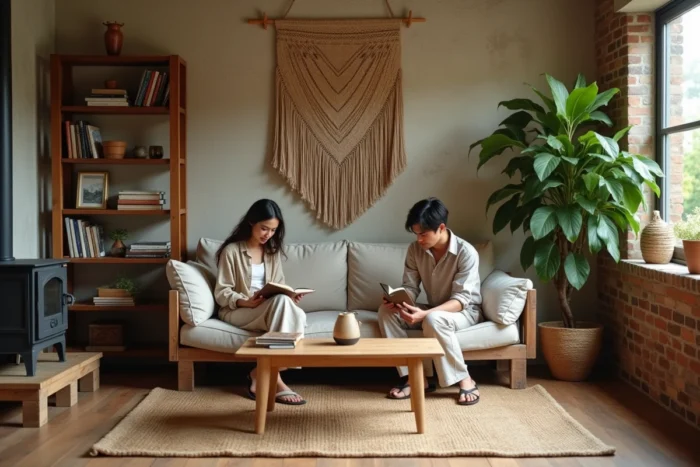
When we talk about eco-responsible decoration, the reflex is to think “recycled wood furniture.” The idea is not bad, but we can go further by considering the origin and transformation of the materials present in each room.
Natural coatings and bio-sourced paints
A lime or clay plaster naturally regulates indoor humidity. We refer to hygroscopic materials: they absorb excess water vapor when the air is humid, then release it when the air dries out. The result is an interior that feels less stale, even with closed windows in winter.
Bio-sourced paints, formulated without harmful volatile organic compounds, contribute to the same goal. A healthier indoor air is built layer by layer, from the wall to the furniture.
Textiles and everyday objects
For curtains, cushions, and household linens, it’s beneficial to prioritize linen, hemp, or unbleached organic cotton. These fibers age well, develop a patina over time, and withstand dozens of washes without losing their shape.
- Linen grown in Europe (notably in Normandy and Flanders) has a very low water footprint compared to conventional cotton
- Hemp grows without pesticides and produces a fiber that is naturally resistant to mold
- Local wool, when available, provides appreciable sound insulation for blankets and thick rugs
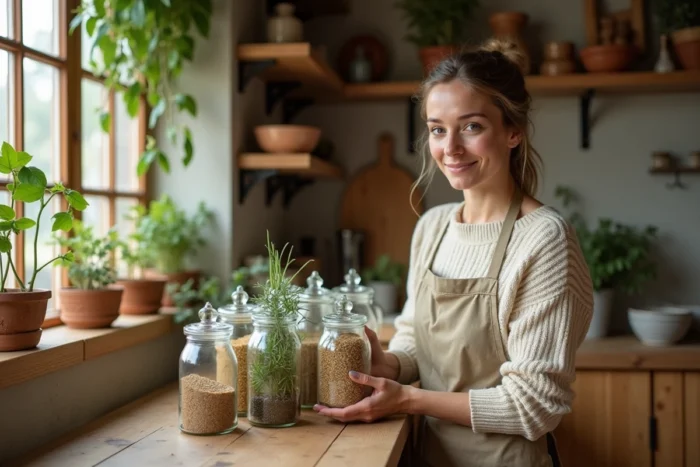
For everyday objects (dishes, storage, accessories), the zero waste logic encourages replacing plastic with durable containers: glass jars, stoneware jars, woven baskets. The change is gradual, piece by piece.
Waste reduction in daily life: habits that last
We have all seen “zero waste” ultra-minimalist interiors on social media. In real life, a lasting zero waste approach relies on five or six well-established changes, not on a complete lifestyle overhaul in a weekend.
The first lever is the kitchen. Replace plastic wrap with fabric bowl covers, store dry foods in jars, compost peels if you have a garden or a worm composter. These actions become automatic within a few weeks.
The second lever concerns household products. Making a multi-purpose cleaner from white vinegar, baking soda, and essential oil takes less than ten minutes. You reduce the number of plastic bottles under the sink and control the composition of what you breathe at home.
Lighting and warm ambiance without energy waste
Lighting is often a neglected aspect in an eco-responsible approach, yet it defines the atmosphere of an interior. A house can be technically impeccable and still feel cold if the lighting is poorly designed.
- Favor LED bulbs with a color temperature around 2,700 K for living areas (living room, bedroom): this is the hue that most closely resembles candlelight
- Multiply low-power light points rather than relying on a single central ceiling light, to create intimate zones
- Use fixtures made from natural materials (rattan, wood, ceramic) that diffuse light softly and unevenly
- Maximize natural light by clearing the areas around windows and choosing light linen curtains
Good eco-responsible lighting combines energy efficiency and visual warmth. Feedback varies on this point, but most residents of low-energy homes report that the lighting ambiance has as much impact on their feelings as the indoor temperature.
Eco-responsible Christmas gifts and decorations: a real-world test
The Christmas season is a good revealer of the coherence of an approach. You can decorate without plastic by using natural elements (fir branches, pine cones, dried citrus) and reusable fabric to wrap gifts.
For the gifts themselves, DIY and second-hand items advantageously replace new purchases when you take the time to target the recipient’s tastes. A thrifted or handmade item tells a story, giving it more perceived value than a product straight out of a box.
Making your home eco-responsible and warm does not require a huge budget or a radical shift. The most sustainable choices are those made piece by piece, season after season, testing what truly works in your own daily life.