The disability card or the inclusion mobility card marked “disability” (CMI-I) does not, by itself, grant entitlement to a property tax exemption. This confusion, common in public content, leads many taxpayers to file claims that are destined to fail. The mechanism is based on the allowances received and the reference tax income, not solely on the disability rate.
Property tax and disability: the pivotal role of allowances, not the card
The total exemption from property tax on the primary residence does not stem from holding a CMI-I. It is reserved for beneficiaries of three specific allowances:
- The adult disability allowance (AAH), subject to a reference tax income not exceeding the thresholds set each year by the tax administration.
- The additional disability allowance (ASI), paid to disabled individuals with low resources who have not yet reached the legal retirement age.
- The solidarity allowance for the elderly (Aspa), which concerns retirees with low incomes, including those whose disability was recognized before the liquidation of their pension.
We regularly observe that holders of the CMI-I receiving income above the thresholds are denied any property tax exemption. The card proves a disability rate, but the general tax code conditions the property tax relief on the combination of allowance plus reference tax income.
The property tax reductions for disability card therefore require, in practice, to check eligibility for one of these allowances before requesting a relief from the public finance center.

Property tax exemption: income conditions and housing occupancy
Receiving the AAH or ASI is not enough. The administration checks two additional criteria that block many applications.
Reference tax income ceiling
The household’s reference tax income (year N-1) must remain below a threshold re-evaluated each year and published in the Official Bulletin of Public Finances. This ceiling varies according to the number of shares in the family quotient. A household with an additional half-share for disability raises the threshold, which can shift a taxpayer to the side of eligibility.
The half-share for disability indirectly increases the chances of property tax exemption, even though it primarily affects income tax. We recommend systematically checking box P (declaring 1) or F (declaring 2) on the income tax return so that this half-share is included in the calculation of the reference tax income.
Housing occupancy condition
The exempt property must constitute the taxpayer’s primary residence. Any secondary residence is excluded. For individuals residing in nursing homes or assisted living facilities, the previously occupied housing as a primary residence remains eligible for exemption, provided it is neither rented nor occupied by a third party.
This point is often overlooked: moving to a nursing home does not result in losing the property tax exemption if the housing remains vacant and unoccupied.
Half-share for disability and income tax declaration: boxes and supporting documents
The additional half-share for disability concerns income tax, not directly property tax. It is obtained under one of these conditions:
- Being the holder of the CMI marked “disability” or the old disability card (disability rate of at least 80%).
- Receiving a disability pension for work-related accidents of at least 40%.
- Receiving a military disability pension of at least 40%.
On the online declaration, box P corresponds to declaring 1, box F to declaring 2. For a dependent child holding the CMI-I, box G applies. The CMI-I can be declared as of the date of submission of the application to the MDPH, even before the physical receipt of the card, provided the supporting document is submitted upon receipt.
The half-share for disability can be combined with other increases (dependent children, single parent), which can significantly lower the reference tax income and, by extension, open the right to property tax exemption.
Tax relief and property tax capping: the little-known safety net
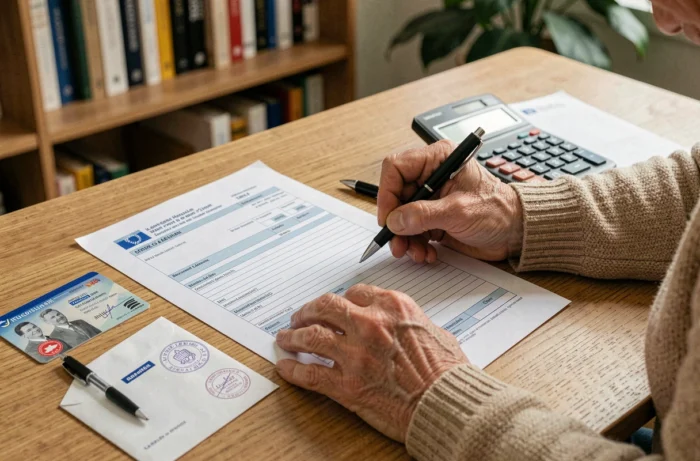
When neither the total exemption nor the allowance conditions are met, a capping mechanism remains. The property tax on the primary residence can be capped based on the reference tax income: the portion that exceeds a certain percentage of the income is automatically relieved.
This relief is automatic if the income tax return is correctly filled out. In practice, we find that disabled taxpayers who did not check box P or F lose the benefit of the half-share, which artificially inflates their reference tax income and excludes them from the capping.
An error in the box on the income tax return can cost several hundred euros in excess property tax. Claims are possible for three years, via the secure messaging of the online tax account or by mail to the public finance center.
For taxpayers who discover their eligibility late, the request for retroactive reimbursement covers the current year and the two previous years. Including a copy of the CMI-I and the tax notice speeds up the processing of the file.
The link between disability and property taxation goes through a chain of technical conditions that the mere possession of the card does not summarize. Checking the allowance received, the reference tax income, and the boxes checked on the declaration remains the most reliable method to secure each available relief.