
Losing a loved one, going through a breakup, facing a serious illness: these moments shake both the body and inner references. Seeking psychological and spiritual support helps prevent one from facing suffering alone. Far from opposing therapy and the search for meaning, this approach connects them to help the individual regain stable support when everything seems to be wavering.
When traditional therapy is not enough to provide meaning
Have you ever noticed that after a trauma, emotions can be calmed without the feeling of emptiness disappearing? Psychological support helps to understand the mechanisms of stress, regulate anxiety, and articulate what hurts. It acts on both cognitive and emotional levels.
The spiritual dimension operates in another realm: that of meaning. In the face of grief or exile, for example, the question is no longer just “how to feel better” but “why continue.” Recent research on supporting refugees documents this phenomenon. The reconstruction of narrative meaning, which involves reintegrating a painful event into a coherent life story, emerges as a central mechanism for change.
This is not a question of religion. An atheist may need to reconsider their view of existence after a collapse. A believer may go through a crisis of faith that exacerbates their distress. Psycho-spiritual support takes both dimensions into account without imposing a doctrinal framework.
Practitioners offer this integrative approach, as can be discovered on alinearchimbaud.fr, by combining therapeutic tools and exploration of the relationship to meaning in a confidential setting.
Emotional regulation and contemplative practices: how it works
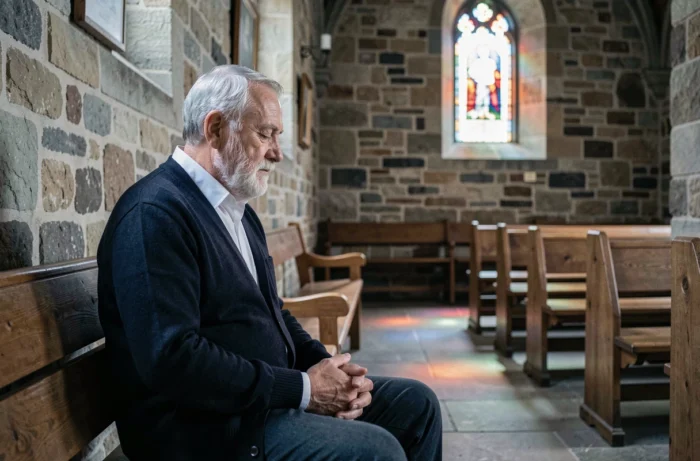
Mindfulness meditation is now well-documented in clinical psychology. Its use in a spiritual context adds an extra layer: contemplative emotional regulation aims not only for calm but for inner grounding.
In practice, this can take several forms:
- A guided meditation focused on self-compassion, useful after a professional failure or a separation, where the person learns to observe their suffering without identifying with it.
- Breathing exercises associated with an intention of letting go, not in a vague sense, but as a voluntary act of relinquishing control over what does not depend on oneself.
- Work on deep beliefs (religious or otherwise) that fuel guilt, shame, or feelings of injustice in the face of adversity.
The goal is not to replace psychotherapy. Generalized anxiety disorder or severe depression requires clinical follow-up. The spiritual approach complements therapy; it does not substitute it.
Collective rituals and community support in the face of grief
Grief may be the experience where the spiritual dimension manifests most naturally. Funeral rituals, whether religious or secular, serve a precise psychological function: they structure the transition between presence and absence.
Research on psycho-spiritual interventions identifies collective healing and mourning rituals as a distinct family of support. These rituals are not limited to the funeral ceremony. They include talking circles, regular commemorative times, and symbolic practices of gradual separation.

What makes them effective is the community belonging they reinforce. Going through a trial alone increases the risk of withdrawal and chronic suffering. The group, even a small one, offers a mirror and a container. The bereaved person finds a place, a role, and recognition of their pain.
Be careful to distinguish this structured framework from certain deviations. Serious spiritual support does not promise miraculous healing, does not create dependency on a charismatic guide, and respects freedom of belief. If the practitioner imposes a belief system or discourages recourse to medicine, it is a clear warning sign.
Choosing psycho-spiritual support suited to one’s situation
Not all trials mobilize the same inner resources. A chronic illness confronts one with the loss of control over the body. A dismissal affects social identity. A perinatal loss leads to a collapse of life plans. The right support is the one that recognizes the specificity of each trial.
Some guidelines to help direct your choice:
- Check the practitioner’s training: a competent psycho-spiritual supporter has training in psychology or helping relationships, complemented by a background in the spiritual or existential field.
- Clarify the framework from the first session: confidentiality, duration, frequency, absence of proselytism. A rigorous professional establishes these foundations without needing to be asked.
- Evaluate relational compatibility: trust is the foundation of this type of support. Without it, neither psychological work nor spiritual exploration can progress.
The complementarity between approaches remains central. A person may undergo cognitive behavioral therapy to manage anxiety attacks while simultaneously working on the meaning of their experience in a spiritual context. The two approaches nourish each other when conducted by practitioners who communicate with one another.
Psycho-spiritual support does not offer ready-made answers to life’s trials. It opens a space where the individual can pose their deepest questions without being directed to a standardized protocol. It is often in this space, between therapeutic dialogue and contemplative silence, that something begins to move again.