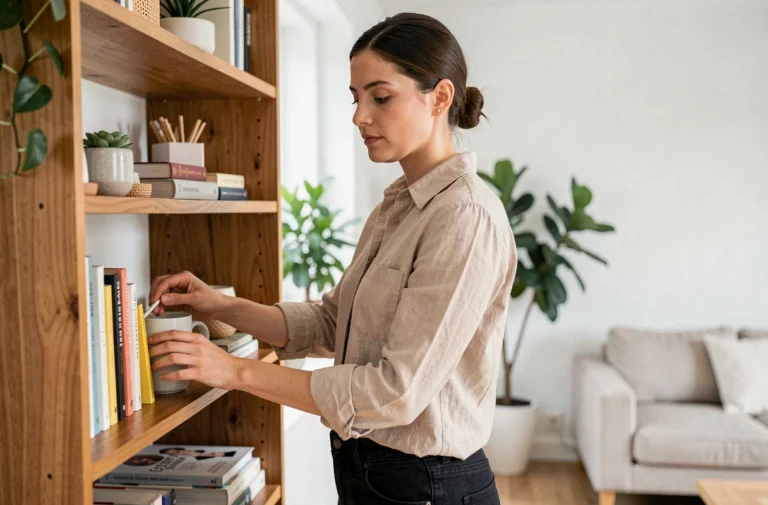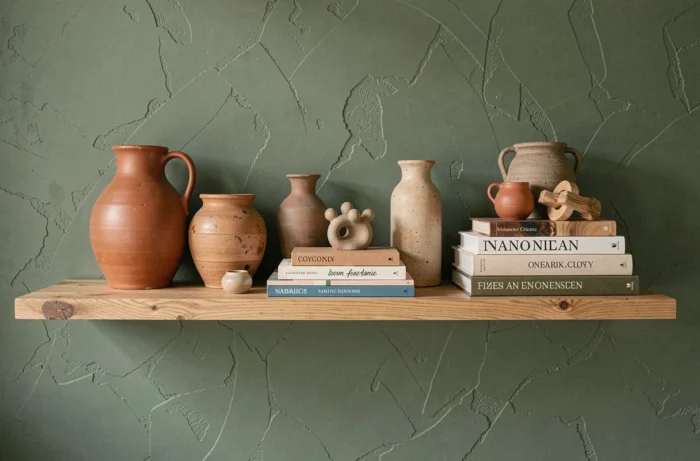
An interior with character does not rely on a substantial budget or the latest trendy catalog. It is based on precise choices, sometimes just one well-placed object that changes the perception of an entire room. Original decoration and unusual objects are two complementary levers to break away from a generic living room, provided you understand how they work together rather than just accumulating them.
Neutral background and sculptural object: the principle of visual contrast
Have you ever noticed that a highly detailed object placed on a cluttered piece of furniture completely disappears? This is the most common trap when trying to give style to your interior. An unusual object needs visual space around it to exist.
The 2026 trend confirms this principle. Pantone has designated Cloud Dancer, a luminous off-white, as the color of the year. This shade serves precisely as a neutral base to highlight sculptural or colorful pieces. Placing a vase with organic shapes or a handmade lamp against a very light background makes the object readable without creating a cluttered effect.
Specifically, before buying a new decorative object, look at the wall or piece of furniture that will host it. If the surface is already saturated with colors or patterns, the original object will only add noise. A warm beige, greige, or off-white background transforms any unusual piece into a focal point. Brands like Bazaar & Compagnie offer just this type of decorative objects with strong personality, designed to work against sober backgrounds.
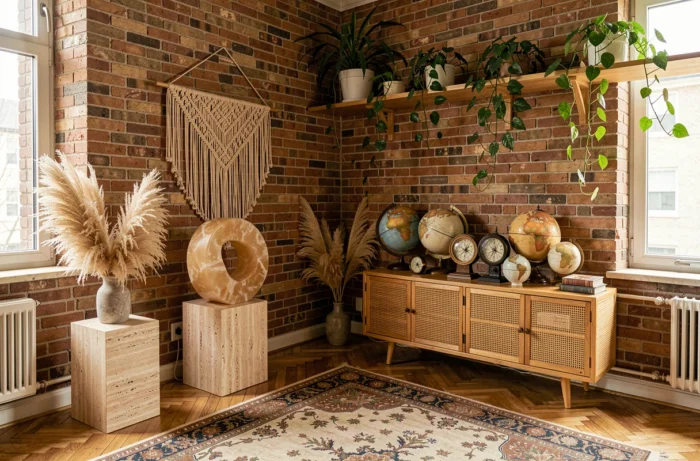
Dark color palette: daring plum and midnight blue for an atypical living room
Duck blue and terracotta tones have dominated interiors in recent years. In 2026, several trend analyses (Le Tribunal du Net, Marie Claire Maison) indicate a clear shift: plum, dark chocolate, midnight blue, and yellow ochre are taking over. These colors create more enveloping and sophisticated atmospheres.
This change in palette has a direct impact on the choice of unusual objects. A brass or amber glass object that seemed mundane in a terracotta living room becomes striking against a midnight blue wall. The color of the background alters the perception of each decorative piece.
Pairing a dark wall with a light object
The principle is simple: a dark wall acts as a showcase. A white ceramic mask, a light wood sculpture, or a mirror with a golden frame gain presence against a plum or chocolate background. The mistake would be to place a dark object on a dark wall, which drowns out the whole.
For a living room, just one wall painted in a deep shade is enough. Concentrate your original objects in this area. The rest of the room can remain neutral, which avoids a cave-like effect and preserves natural brightness.
Second-hand furniture: finding unique pieces without producing new
The second-hand market for furniture and decoration is experiencing significant growth in France. It is no longer a default choice: it has become a style approach in its own right. A solid oak farmhouse table from the 1950s, an industrial architect lamp, or a patinated club chair brings a uniqueness that no mass-produced new furniture can replicate.
Are you looking for unusual objects for your home? Flea markets, recycling centers, and specialized platforms are full of pieces that exist in only one copy. Their wear even contributes to their decorative character.
What to check before buying
- Structural integrity: a vintage piece may have charm, but a wobbly leg or a stuck drawer makes it unusable on a daily basis. Always test the mechanisms on-site.
- Compatibility with your space: measure beforehand. An imposing Art Deco buffet loses all its effect in a narrow hallway where it obstructs movement.
- Material coherence: mixing raw wood, metal, and ceramic works well, but accumulating five different materials in one space creates an impression of unintentional clutter.
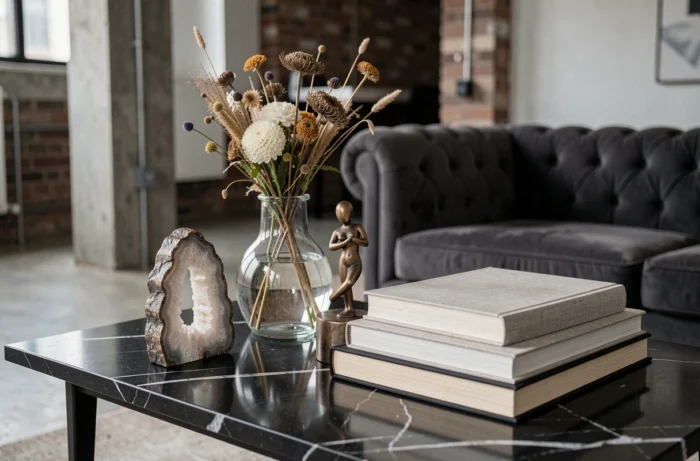
Wall art and repurposed objects: creating a focal point without overloading
An original interior is not built by filling every shelf. It is built by choosing a focal point for each room, an element that draws the eye and sets the tone. Everything else plays a discreet supporting role.
Repurposing everyday objects is an underutilized lever. An old copper cake mold hung on the wall becomes a design piece. A collection of colored glass bottles lined up on a windowsill filters light and creates a chromatic play. The most effective unusual object is often one that was not designed for decoration.
Organizing a gallery wall without a catalog effect
The gallery wall (several frames grouped together) remains a classic, but it quickly turns cliché when all the frames are identical and perfectly aligned. For an atypical result:
- Mix formats: a large canvas, two small frames, a three-dimensional object (mask, plate, antique pocket mirror).
- Vary mediums: a black and white photograph next to an original watercolor and a framed textile.
- Leave an asymmetrical space between pieces. Controlled irregularity gives a natural effect, as if the collection had built up over time.
- Limit the whole to a specific area of the wall rather than covering the entire surface.
The common thread of these approaches: they rely on restraint. A stylish interior is not a filled interior; it is an interior where each object has a reason to be there. When you hesitate between adding one more object or leaving an empty space, the empty space is almost always the best answer.