
We need to send a file to a foreign authority, and the list of required documents includes a “certified true copy.” The natural reflex would be to go to the town hall, but the administrative reality in France has changed a long time ago. Certifying a document oneself remains possible in certain cases, provided that a specific framework is followed to avoid any rejection of the file.
Affidavit: the certified true copy that you write yourself
Since 2001, French administrations are no longer allowed to require a certified true copy for an internal procedure, except for specific regulatory texts. In practice, when a French organization requests a “certified true copy,” it can be replaced by a sworn statement of conformity to the original.
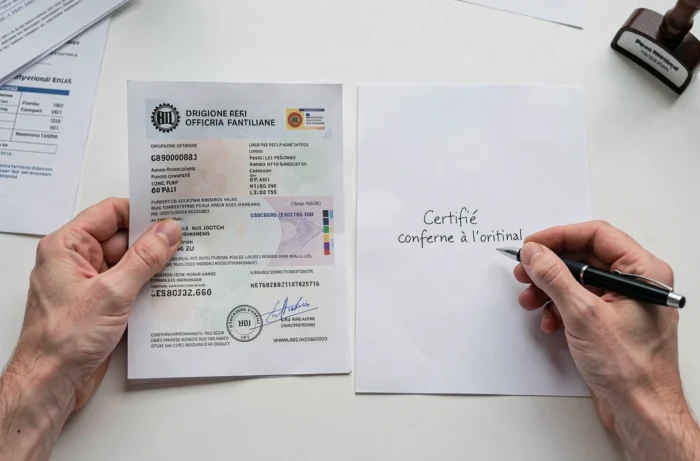
Specifically, you photocopy the document, then write a handwritten or typed statement such as: “I, the undersigned, [name, first name], hereby certify that this copy is true to the original.” You add the date, location, and signature. This statement has real legal value under French law, as any false declaration under oath is subject to criminal penalties.
To understand how to certify a document yourself, it is important to note that this route only works for national procedures. As soon as a foreign recipient is involved, the rules change.
Certified true copy for abroad: who can issue it

When a third country explicitly requires a certified true copy, the sworn statement is no longer sufficient. You must go through an authorized third party. In France, several entities can provide this certification:
- The town hall of your residence, which remains the most accessible counter for individuals. You present the original and the photocopy, an agent compares the two and affixes the stamp.
- A notary, whose certification has enhanced probative force. This option incurs fees, but it is sometimes the only one accepted by certain foreign jurisdictions.
- The public archive services, when they hold the original document. The request must then be justified by a specific reason (foreign administrative need, judicial need, establishment of a right).
A point often overlooked: certification remains strictly paper-based. Public archive services do not issue an electronic version of this certification. If you are working on a digital file, you will need to scan the certified document afterward.
Qualified electronic signature and certification of digital documents
The question arises differently for natively digital documents. An electronically signed contract, a dematerialized act, or a digital Kbis extract do not have a “paper original” to photocopy. The logic of the classic certified true copy does not apply.
To guarantee the authenticity of an electronic document, we rely on the qualified electronic signature. This level, defined by the European eIDAS regulation, offers the same legal value as a handwritten signature. It is based on a certificate issued after face-to-face identity verification or an equivalent process.
The integrity of the document is ensured by an electronic seal or a qualified timestamp. These mechanisms guarantee that the file has not been modified since its creation. For companies that manage regular document volumes, a document management solution with a qualified signature replaces the certified true copy in most digital exchanges.
Common mistakes that lead to rejection of a certified true copy
On the ground, rejections of files related to certified true copies follow recurring patterns. Identifying these pitfalls before sending the file avoids weeks of delays.
- Sending a sworn statement to a foreign administration that requires an official stamp. The document is systematically returned.
- Having a poor-quality photocopy certified. If the town hall agent cannot clearly read the document, they will refuse to affix the stamp.
- Forgetting to check if the recipient country additionally requires an apostille or legalization. The certified true copy and the apostille are two distinct processes, and one does not replace the other.
- Presenting a document in a foreign language without a sworn translation. The certification pertains to the conformity of the copy, not the validity of the content, but some town halls refuse to process a document they cannot read.
Responses vary among town halls regarding the acceptance of foreign documents for certification. Before going, a call to the civil status service of the municipality can save time.
Certified copy and archiving: maintaining probative value
Once the certified copy is obtained, the question of storage arises. A certified paper document loses all value if it can no longer be found or if it deteriorates. For digital documents, archiving with probative value requires continuous timestamping and integrity control.
In terms of privately signed documents, the rule of double original remains a useful precaution for commercial contracts. Each party keeps a signed copy, which limits the need for subsequent certification.
For individuals, keeping the original and the certified copy in two separate locations (bank safe and home, for example) protects against loss. The certified true copy is only valid as long as it can be physically produced, as no electronic version exists for this type of official document.